Activities
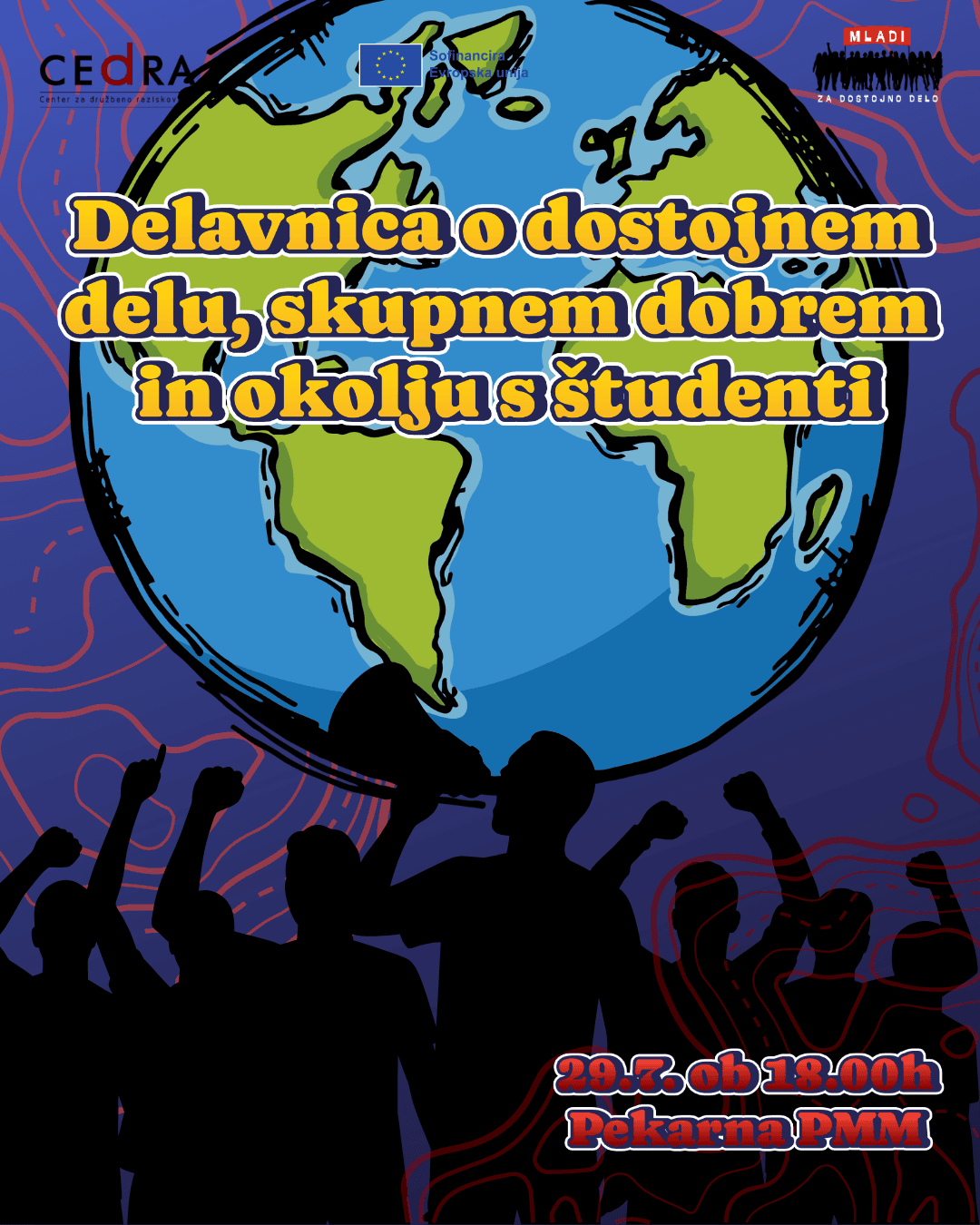
Workshop on Decent Work, the Common Good and the Environment with University Students
At CEDRA, we are continuing our activities as part of the project Youth for Decent Work, the Common Good and the Environment. We invite you to join our next workshop: This time, together with university students, we will explore fast fashion as a concrete example of the connections between consumption, global supply chains, workers' rights and environmental issues. Using everyday clothing as a starting point, we will examine its journey from production to sale and consider who is involved at different stages, the conditions under which people work, and how power, responsibility and economic interests are distributed among different actors. In the practical part of the workshop, participants will work in smaller groups to analyse the positions of workers, factory owners, major brands, retailers and consumers. Together, we will consider possibilities for improving working conditions, the limits of individual responsibility and the importance of collective solutions. Particular attention will be paid to trade union organising, solidarity and the role of companies and public institutions in ensuring decent work.
Activity Report
Event Report: Workshop on Decent Work, the Common Good and the Environment with University Students
Date: 29 July 2026
Context: Erasmus+ project Youth for Decent Work, the Common Good and the Environment (KA145)
Location: Pekarna Magdalenske mreže, Ob železnici 6, 2000 Maribor
1. Description of the Activity
As part of the project, we organised a workshop with university students focusing on fast fashion as a concrete example of the connections between consumption, global supply chains, workers' rights and environmental issues. The activity was designed to enable participants to explore broader social, economic and environmental processes through products they encounter in their everyday lives.
Using everyday clothing as an example, participants analysed the journey of a product from production to sale and considered who is involved at different stages of production and distribution, the interests of different actors and the position of workers within global supply chains.
Participants then worked in smaller groups. Each group examined a specific problem related to work in global supply chains and analysed the positions and interests of different actors – workers, factory owners, major brands, retailers and consumers. Particular attention was paid to how power, responsibility and the ability to influence working conditions are distributed among different actors.
This was followed by a joint reflection in which the groups presented and compared their findings. The discussion focused on individual and collective responsibility, the importance of trade union organising and the role of companies and public institutions in ensuring decent work.
The workshop enabled participants to connect everyday consumption with broader questions of global inequality, workers' rights, economic interests, environmental responsibility and possibilities for collective action.
2. Purpose of the Activity
The objectives of the workshop were:
- to introduce university students to the functioning of global supply chains through the concrete example of fast fashion,
- to deepen their understanding of the position of workers in the textile industry and global production processes,
- to explore the connections between consumption, production, working conditions and environmental issues,
- to develop an understanding of different interests and power relations between actors within supply chains,
- to encourage critical reflection on individual and collective responsibility,
- to deepen participants' understanding of the importance of trade union and collective organising in improving working conditions,
- to encourage reflection on the responsibility of companies and public institutions in ensuring decent work,
- to develop solidarity with workers experiencing insecure and unequal working conditions.
3. Process and Youth Participation
The workshop was based on the active participation of students and combined group discussion, analysis of concrete examples and work in smaller groups.
a) Fast Fashion as a Starting Point for Understanding Global Processes
The introductory part began with clothing as an everyday product familiar to all participants. Together, we considered the journey of an individual product from production to sale and the many people and companies involved in this process.
In this way, we connected everyday consumption with broader questions of global production, economic relations, workers' rights and environmental responsibility.
b) Global Supply Chains and the Position of Workers
We then analysed the basic structure of global supply chains. Participants considered different stages of production and distribution and the position of workers within these processes.
Particular attention was paid to who makes key decisions, who has the greatest ability to influence production conditions and how economic power differs between individual actors within the supply chain.
c) Group Work and Analysis of Different Actors
Participants divided into smaller groups and examined specific problems related to work within global supply chains.
The groups analysed the positions and interests of workers, factory owners, major brands, retailers and consumers. They considered the ability of each actor to influence working conditions and how power, responsibility and economic interests are distributed throughout the supply chain.
d) Individual and Collective Responsibility
An important part of the discussion focused on responsibility. Participants considered the extent to which individual consumers and workers can influence existing conditions and the limitations of individual action.
The discussion then moved towards collective and systemic approaches to changing these conditions, including workers' organising, corporate responsibility and the role of public institutions.
e) Trade Union and Collective Organising
Particular attention was paid to the position of individual workers within global economic relations. Participants discussed why individual workers often have limited ability to influence their working conditions and how their position can change when workers come together and organise collectively.
This provided a basis for discussing the importance of trade union organising, solidarity and collective representation of shared interests.
f) Joint Reflection
In the final part of the workshop, the groups presented their findings and compared different perspectives and proposed solutions.
The joint reflection demonstrated that working conditions within global supply chains cannot be understood solely as a question of individual workers' or consumers' choices. Participants recognised the importance of broader economic relations, power structures, collective organising and the responsibility of companies and institutions.
4. Achieved Results
The activity was evaluated through a questionnaire and group reflection. Participants assessed their understanding of global supply chains, the position of workers in the textile industry, the usefulness of group work, the importance of collective organising and the relevance of the topics discussed.
The average scores on a five-point scale were:
- understanding of global supply chains: 4.6 / 5,
- understanding of the position of workers: 4.6 / 5,
- usefulness of group work: 4.2 / 5,
- understanding of the importance of collective organising: 4.5 / 5,
- relevance of the topics discussed: 4.8 / 5.
The unequal distribution of power and responsibility within global supply chains emerged as a particularly important issue during the group reflections. Participants recognised that different actors do not have equal opportunities to influence production and working conditions.
Participants particularly emphasised that individual workers have limited ability to influence their working conditions without the support of their colleagues and organised collective action. This provided an important basis for discussing trade union organising, solidarity and collective representation of interests.
The high average score for the relevance of the topics discussed (4.8 / 5) indicates that participants recognised global supply chains, workers' rights and fast fashion as issues directly connected to contemporary social and working conditions.
The activity therefore contributed to:
- a better understanding of how global supply chains function,
- a deeper understanding of the position of workers in the textile industry,
- an improved ability to recognise the interests and power relations of different actors,
- an understanding of the limitations of individual action and the importance of collective solutions,
- a deeper understanding of the importance of trade union organising,
- connecting everyday consumption with questions of decent work, global inequality and environmental responsibility.
5. Learning Outcomes and Contribution to the Project Objectives
The workshop made an important contribution to the project objectives by enabling university students to explore the connections between decent work, economic relations, consumption, the common good and environmental issues through the concrete and everyday example of fast fashion.
In terms of knowledge, participants gained or deepened their:
- understanding of how global supply chains function,
- knowledge of working conditions in the textile industry,
- understanding of power relations between workers, companies and consumers,
- understanding of the connections between consumption, production and working conditions,
- understanding of the importance of trade union and collective organising.
In terms of skills, participants developed their ability to:
- identify the interests and positions of different actors,
- analyse power relations within global supply chains,
- cooperate and develop shared conclusions in smaller groups,
- participate in joint reflection and discussion using reasoned arguments,
- connect everyday consumption practices with broader social and economic processes.
In terms of attitudes and behaviour, the activity contributed to:
- greater awareness of unequal working conditions,
- stronger solidarity with workers in insecure working conditions,
- greater willingness to search for solutions collectively,
- greater awareness of the importance of collective action,
- the development of a critical perspective on the unequal distribution of power and responsibility within global economic relations.
The activity therefore directly supported the objectives of the Erasmus+ project Youth for Decent Work, the Common Good and the Environment. Through the concrete example of fast fashion, participants connected everyday life and consumption practices with global economic processes, workers' rights and environmental issues, while developing an understanding that ensuring decent work and the common good also requires collective and systemic solutions.
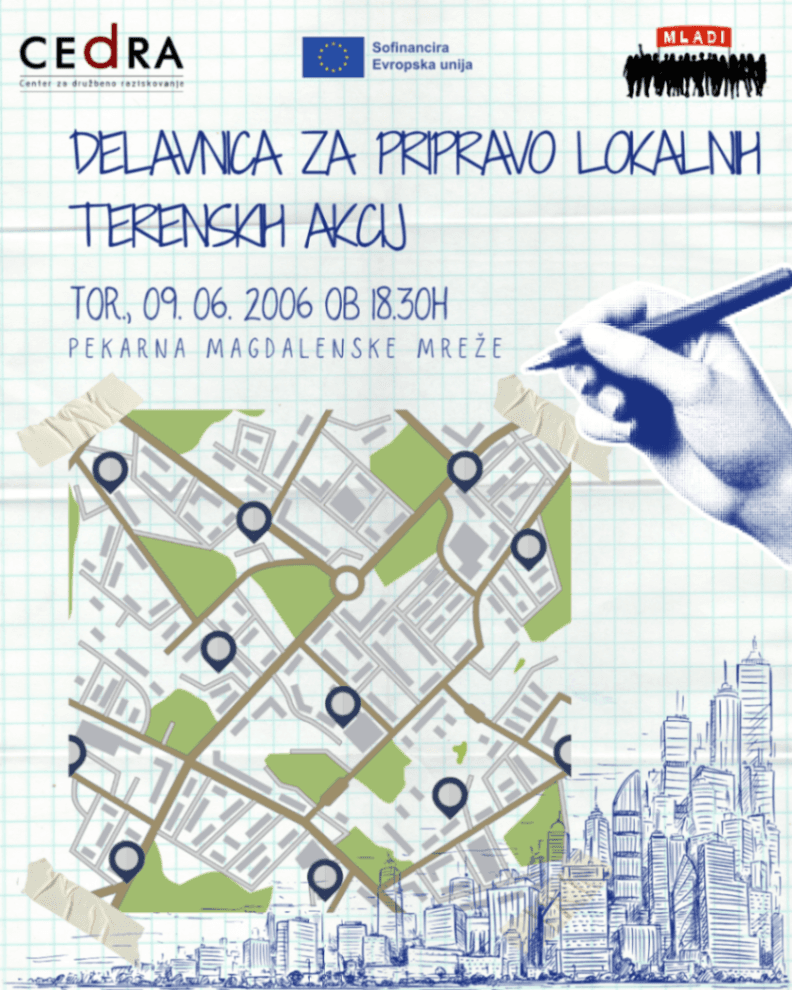
Workshop for Preparing Local Field Actions
At CEDRA, we are continuing our activities as part of the project Youth for Decent Work, the Common Good and the Environment. We invite you to join our next workshop: This time, we will focus on preparing local field actions and establishing direct contact with workers in their workplaces. Drawing on practical experiences from trade union organising, we will explore how to approach workers, establish initial contact and open conversations about their working conditions, problems and needs. Particular attention will be paid to active listening and identifying problems and interests shared by larger groups of workers. In the practical part of the workshop, we will prepare concrete workplace visits, identify key topics and questions for conversations, and form field teams. We will divide responsibilities within the teams and prepare methods for systematically recording findings from the field. The workshop will therefore enable participants to put their knowledge into practice by preparing concrete local activities.
Activity Report
Event Report: Workshop for Preparing Local Field Actions
Date: 14 May 2026
Context: Erasmus+ project Youth for Decent Work, the Common Good and the Environment (KA145)
Location: Pekarna Magdalenske mreže, Ob železnici 6, 2000 Maribor
1. Description of the Activity
As part of the project, we organised a workshop for preparing local field actions, designed to provide young participants with practical preparation for workplace visits and direct contact with workers. The activity was conceived as a practical continuation of the project's work on decent work, workers' rights, solidarity and collective organising.
In the first part of the workshop, participants learned about establishing contact with workers in the workplace through the presentation and exchange of experiences from trade union organising practice. They explored which topics can be useful to address and how conversations with workers can help identify problems and interests shared by a larger number of employees.
Particular attention was paid to understanding fieldwork as a process of listening, building trust and developing long-term relationships with workers. Participants discussed the difference between individual difficulties and problems that can be recognised as shared by a wider group of workers and can therefore provide a basis for collective action.
In the practical part, participants prepared for concrete workplace visits. Together, they defined the purpose of the visits, approaches to initiating contact with workers, key topics for discussion and methods for systematically recording their findings.
In the final part, participants formed field teams and divided the basic responsibilities required for preparing and carrying out the visits. They decided who would establish the initial contact, who would lead the conversation and ask questions, and who would record the key findings.
2. Purpose of the Activity
The objectives of the workshop were:
- to introduce young people to the purpose and basic methods of fieldwork,
- to present practical experiences and methods from trade union organising,
- to develop participants' ability to establish direct and respectful contact with workers,
- to develop active listening and open-ended questioning skills,
- to enable participants to distinguish between individual and shared workplace problems,
- to develop the ability to identify common interests and opportunities for collective action,
- to prepare participants practically for carrying out local field actions,
- to strengthen cooperation, responsibility and a clear division of tasks within field teams.
3. Process and Youth Participation
The workshop had a strongly practical and participatory character and was divided into several interconnected sections:
a) Introduction to Fieldwork
In the first part, we defined the purpose of fieldwork and discussed why direct contact with workers is important for understanding their working and living conditions.
We particularly emphasised that the purpose of a workplace visit is not simply to provide information, but primarily to initiate conversations, listen to workers' experiences and gradually build trust.
b) Experiences from Trade Union Organising
Participants were introduced to concrete experiences from trade union fieldwork. We discussed how to approach workers, how to initiate a conversation, which types of questions encourage people to share their experiences and how to respond to different reactions.
Using practical examples, participants considered which approaches can help create an open and respectful conversation.
c) Active Listening and Asking Questions
An important part of the workshop focused on communication skills. Participants explored the importance of open-ended questions and active listening.
We discussed how to conduct conversations in a way that enables workers themselves to describe their experiences, problems and needs, rather than providing answers in advance or assuming which issues are most important to them.
d) From Individual Difficulties to Shared Problems
Participants learned to distinguish between the individual difficulties experienced by a particular worker and problems that recur among a larger number of employees.
Particular attention was paid to how recurring problems and shared interests can be identified through multiple conversations and how such findings can provide a basis for further connection and collective action.
e) Preparing Concrete Workplace Visits
In the practical part of the workshop, participants planned concrete workplace visits. They defined the purpose of each visit, approaches to initiating contact with workers and the key questions they wanted to address.
Together, we developed a basic framework for field conversations and a method for recording information that would enable subsequent collective analysis of the findings.
f) Forming Field Teams and Dividing Responsibilities
In the final part, participants formed smaller field teams and divided basic roles and responsibilities within each group.
They decided who would establish the initial contact with workers, who would lead the conversation and ask questions, and who would be responsible for recording the key findings.
This division of responsibilities enabled participants to translate their theoretical and practical preparation directly into a plan for concrete collective action.
4. Achieved Results
The activity was evaluated through a questionnaire and group reflection. Participants assessed their understanding of the purpose of fieldwork, the usefulness of experiences from trade union practice, their preparedness for direct contact with workers, their ability to identify shared problems and the usefulness of working in field teams.
The average scores on a five-point scale were:
- understanding of the purpose of fieldwork: 4.5 / 5,
- usefulness of experiences from trade union practice: 4 / 5,
- preparedness for workplace visits: 4.2 / 5,
- understanding of how to identify shared problems: 4.5 / 5,
- usefulness of working in field teams: 4.2 / 5.
Participants particularly highlighted the practical presentation of trade union fieldwork and the preparation of a concrete approach for conversations with workers.
An important insight was that fieldwork is not simply about providing information, but primarily about listening, building trust and identifying problems that workers experience as shared. Participants also emphasised the importance of thorough preparation, a clear division of responsibilities within the group and systematic recording of findings.
An important outcome of the activity was the participants' direct preparation for the next phase of the activities – carrying out workplace visits and engaging in direct conversations with workers.
The activity therefore contributed to:
- a better understanding of the purpose and methods of fieldwork,
- greater preparedness for direct contact with workers,
- the development of active listening and conversation skills,
- an improved ability to identify shared problems and interests,
- an understanding of the importance of trust and long-term relationship-building,
- the practical preparation of field teams and a clear division of responsibilities.
5. Learning Outcomes and Contribution to the Project Objectives
The workshop made an important contribution to the project objectives by enabling young people to move from a theoretical understanding of decent work, workers' rights and collective organising towards the practical development of skills required for active participation in their local communities.
In terms of knowledge, participants gained or deepened their:
- knowledge of how to prepare and carry out workplace visits,
- understanding of the distinction between individual and shared workplace problems,
- understanding of the importance of building trust and developing long-term relationships with workers,
- knowledge of the basic steps involved in preparing a local field action,
- understanding of the importance of systematically collecting and analysing findings from fieldwork.
In terms of skills, participants developed their ability to:
- establish initial contact and conduct conversations with workers,
- ask open-ended questions and practise active listening,
- identify shared problems and interests,
- record and collectively analyse findings from fieldwork,
- plan concrete field activities,
- cooperate and take on different roles within a group.
In terms of attitudes and behaviour, the activity contributed to:
- greater confidence in establishing direct contact with workers,
- greater willingness to participate actively in local field actions,
- the development of a responsible and respectful approach towards the people they engage with,
- greater awareness of the importance of listening and building trust,
- a stronger sense of solidarity and collective action,
- greater willingness to take responsibility within group activities.
The workshop therefore directly supported the participatory dimension of the Erasmus+ project Youth for Decent Work, the Common Good and the Environment. Participants moved beyond learning about and discussing social issues and began preparing practically for active engagement in their local environment, direct contact with workers and identifying opportunities for shared and collective action.
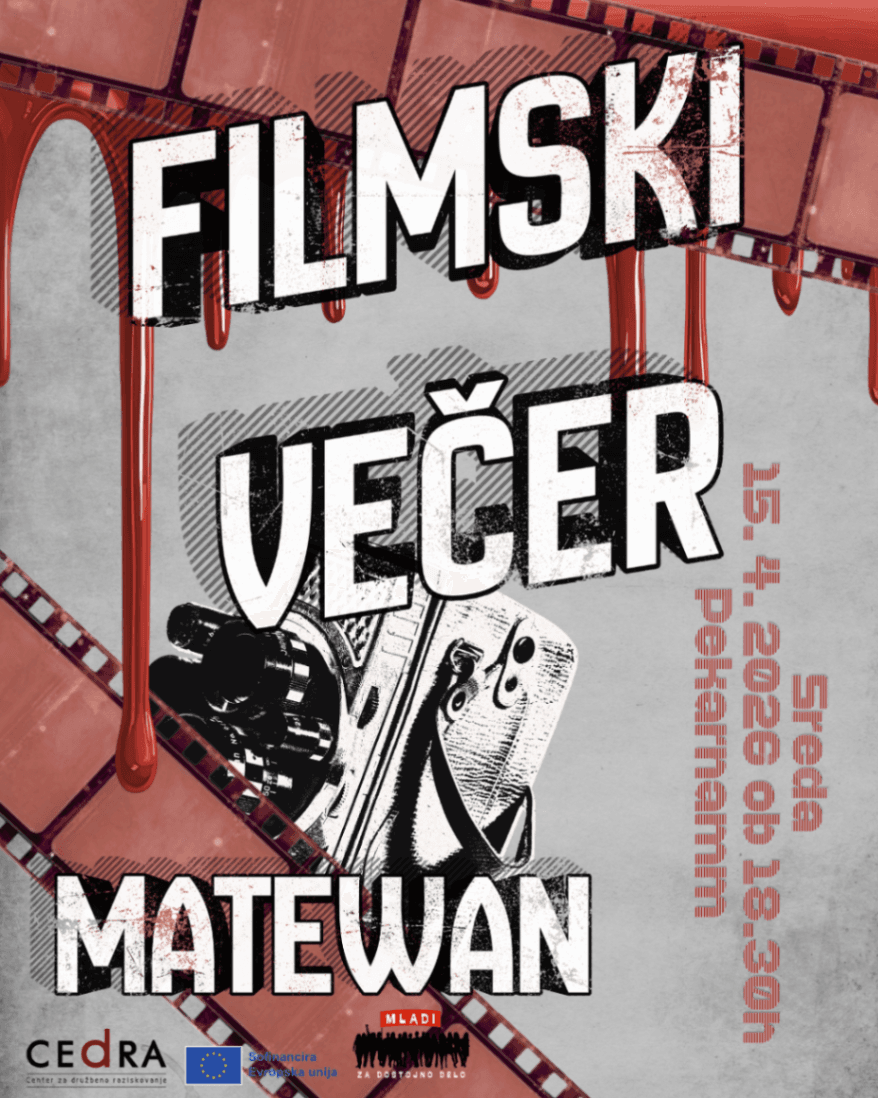
Film Evening – Matewan
At CEDRA, we are continuing our series of film screenings and reading sessions. We invite you to join us for our next event: This time, we will watch Matewan (1987), a film that explores workers' organising, trade unions, strikes and solidarity through the story of a community of mine workers. The film shows how workers attempt to come together and organise collectively in their struggle for better working conditions, while facing pressure from the company as well as racial, ethnic and other divisions among workers. The screening will be followed by a group discussion focusing particularly on the importance of trade union organising and strikes, power relations between workers and companies, and the different ways in which workers' collective organisation can be weakened or prevented. We will also reflect on why overcoming divisions between workers is important for successful collective action and how the historical experiences portrayed in the film can be connected with contemporary conditions in the world of work.
Activity Report
Event Report: Film Evening – Matewan
Date: 14 May 2026
Context: Erasmus+ project Youth for Decent Work, the Common Good and the Environment (KA145)
Location: Pekarna Magdalenske mreže, Ob železnici 6, 2000 Maribor
1. Description of the Activity
As part of the project, we organised the third event in our series of film evenings on workers' rights, decent work and the common good. We screened Matewan (1987), a film that explores workers' rights, trade union organising, strikes, solidarity and power relations between workers and companies through the story of a community of mine workers and their efforts to organise collectively.
Particular attention was paid to the process of collective organising. Through the film, participants observed how workers attempt to build collective organisation despite the differences between them and how the company seeks to weaken their efforts through replacement workers, pressure and the creation of divisions between different groups of workers.
Following the screening, participants took part in a moderated discussion on the importance of trade union organising, strikes and workers' solidarity. They analysed how racial, ethnic, social and other divisions can weaken workers' capacity to act collectively and how such differences can be used to maintain unequal power relations.
The film also provided a starting point for comparing historical forms of workers' organising with contemporary conditions in the world of work and for reflecting on the continuing relevance of collective organisation.
2. Purpose of the Activity
The objectives of the film evening were:
- to use film as a medium to introduce young people to the importance of trade union organising and strikes,
- to deepen their understanding of power relations between workers, companies and institutions,
- to introduce historical examples of workers' organising and conflicts between labour and capital,
- to encourage reflection on the mechanisms that can be used to prevent or weaken workers' collective organisation,
- to emphasise the importance of overcoming racial, ethnic, social and other divisions between workers,
- to develop an understanding of solidarity as an important condition for effective collective action,
- to connect historical experiences of workers' organising with contemporary working conditions and challenges.
3. Process and Youth Participation
The film evening was structured into several interconnected sections:
a) Introduction and Context of the Film
Before the screening, participants were introduced to the basic historical and social context of Matewan. Particular attention was paid to workers' organising, trade unions, strikes and conflicts between the interests of workers and companies.
Participants were encouraged to pay attention to the relationships between different groups of workers, the ways in which they organised and the mechanisms used by the company to prevent them from building collective organisation.
b) Film Screening
Participants watched Matewan together. The film enabled them to follow the development of a workers' collective from initial mistrust and division towards the gradual development of solidarity and collective action.
Particular attention was paid to the role of trade union organising and strikes and to the question of how collective action can change the balance of power between individual workers and a company.
c) Trade Union Organising and Strikes
Following the screening, we discussed the role of a trade union as a structure that enables individual workers to come together around shared interests.
Participants analysed the importance of strikes as a form of collective action and considered why a group of organised workers occupies a different position from an individual worker confronting an employer alone.
d) Mechanisms for Preventing Collective Organisation
An important part of the discussion focused on the methods used by the company in the film to weaken the strike and workers' organising efforts.
Participants identified the use of replacement workers, pressure, intimidation and the encouragement of conflicts between different groups as methods of weakening workers' collective power.
The discussion also enabled participants to compare these historical examples with different forms of pressure and obstacles that workers may encounter when organising today.
e) Divisions Between Workers and the Importance of Solidarity
The central part of the discussion focused on relationships between different groups of workers. Participants analysed how racial, ethnic, social and other differences can affect possibilities for collective action.
We particularly discussed the idea that differences themselves do not necessarily prevent solidarity; what matters is whether different groups are able to overcome divisions and recognise their shared interests.
The film therefore provided an opportunity to reflect on solidarity based on a shared position and collective action despite differences between individuals.
f) Connecting the Film with Contemporary Working Conditions
In the final part of the event, participants compared the conditions presented in the film with the contemporary world of work.
They discussed how workers' organising has changed over time, which problems remain similar and what role trade unions, solidarity and collective action can play in contemporary struggles for decent work and workers' rights.
4. Achieved Results
The activity was evaluated through a questionnaire and group reflection. Participants assessed their understanding of trade union organising, the importance of strikes and collective action, the impact of divisions between workers, power relations between workers and companies, and the relevance of the film's themes to contemporary working conditions.
The average scores on a five-point scale were:
- understanding of the importance of trade union organising: 5 / 5,
- understanding of the importance of strikes and collective action: 4.5 / 5,
- understanding of the impact of divisions between workers: 4 / 5,
- understanding of power relations between workers and companies: 4.5 / 5,
- relevance of the themes to contemporary working conditions: 4.5 / 5.
Participants identified solidarity between workers across racial, ethnic and other differences as one of the film's key themes. The discussion demonstrated an understanding that divisions between different groups of workers can weaken their collective power and benefit those seeking to prevent them from organising.
Particular emphasis was placed on the role of trade unions as structures that bring individual workers together into a collective and enable them to represent their shared interests more effectively. Through the film, participants also developed a better understanding of strikes as a collective means through which workers can influence the balance of power.
The activity therefore contributed to:
- a better understanding of the importance of trade union organising,
- a deeper understanding of strikes and collective action,
- recognition of different methods used to prevent or weaken workers' organising,
- an understanding of how divisions between workers affect their collective power,
- an understanding of the importance of solidarity between workers from different backgrounds,
- connecting historical experiences of workers' organising with contemporary working conditions.
5. Learning Outcomes and Contribution to the Project Objectives
The film evening made an important contribution to the objectives of the project by enabling young people to develop a deeper understanding of workers' rights, trade union organising, collective action and solidarity through a concrete historical example.
In terms of knowledge, participants deepened their:
- understanding of the importance of trade union organising and strikes,
- knowledge of historical forms of workers' organising and conflicts between labour and capital,
- understanding of the importance of solidarity between workers from different racial, ethnic and social backgrounds,
- understanding of power relations between workers, companies and local institutions,
- knowledge of different mechanisms that can be used to prevent or weaken collective organisation.
In terms of skills, participants developed their:
- ability to critically analyse labour and social relations through film,
- ability to recognise mechanisms used to create and exploit divisions between different groups of workers,
- ability to analyse power relations between different social actors,
- ability to connect historical examples of workers' organising with contemporary working conditions,
- ability to participate in reasoned group discussions.
In terms of attitudes and behaviour, the activity contributed to:
- stronger solidarity with workers regardless of their background or social position,
- greater willingness to consider collective approaches to solving problems,
- a better understanding of the importance of overcoming divisions in collective action,
- greater willingness to participate in discussions about workers' rights and decent work,
- greater awareness of the importance of organising and solidarity in advancing shared interests.
The activity therefore directly supported the objectives of the Erasmus+ project Youth for Decent Work, the Common Good and the Environment, particularly by deepening young people's understanding of workers' rights, trade union organising, solidarity and collective action, while developing their ability to critically understand power relations in the world of work.
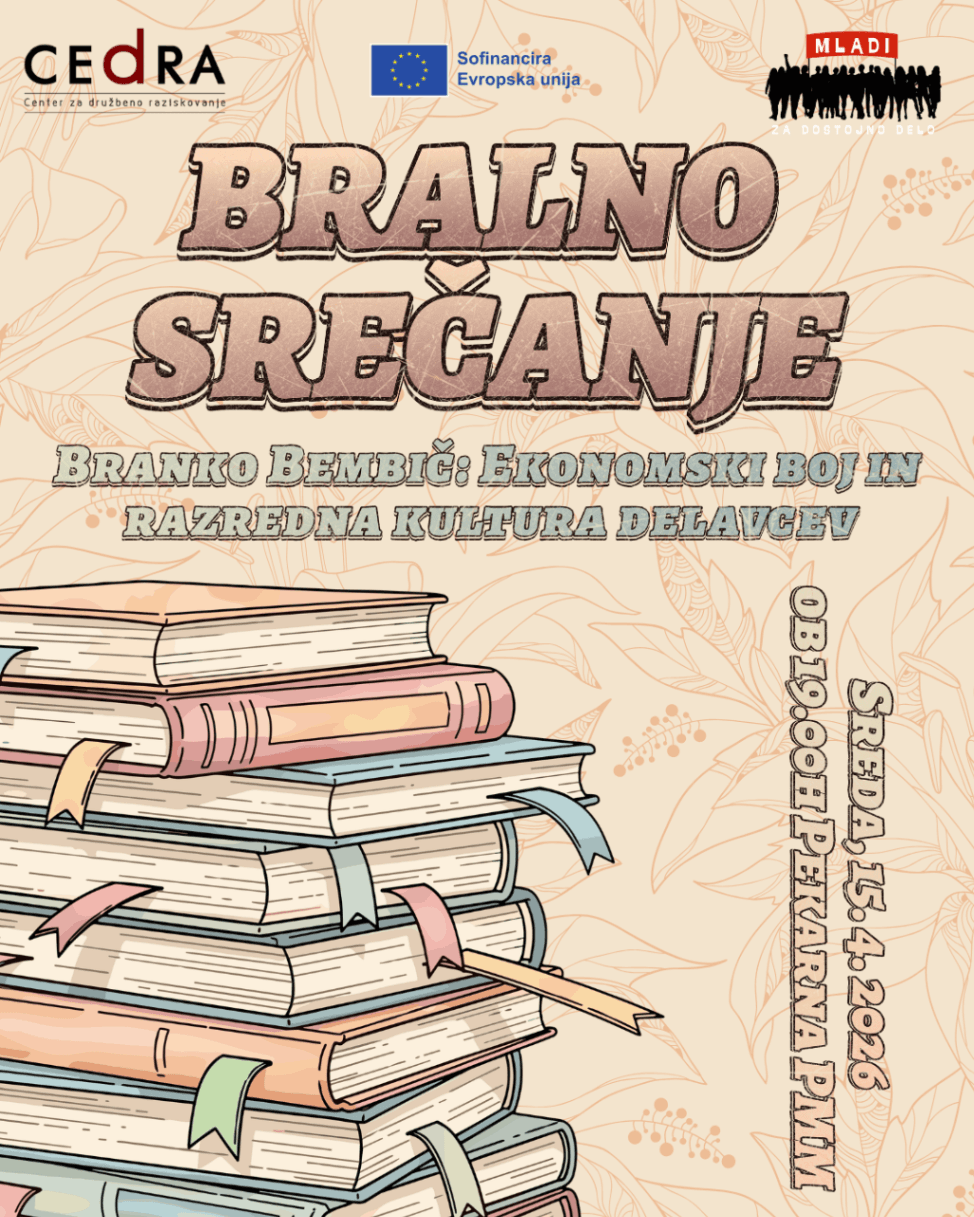
Reading Session – Branko Bembič: Economic Struggle and the Class Culture of Workers
At CEDRA, we are continuing our series of film screenings and reading sessions. We invite you to join us for our next event: We will meet for a reading session to discuss Branko Bembič's text Economic Struggle and the Class Culture of Workers. In the text, the author examines the significance of workers' economic struggles and their role in developing solidarity, collective organisation and class culture. The text raises the question of why workers' struggles for better wages and working conditions are important not only because of the immediate material improvements they can achieve, but also because they can bring workers together, strengthen solidarity and create opportunities for further collective action. You will have time to read the text before the meeting. During the event, we will explore its key arguments together, clarify some of its more complex concepts and connect them with contemporary conditions in the world of work, the role of trade unions and possibilities for workers' organising. The text is attached.
Activity Report
Event Report: Reading Session – Branko Bembič: Economic Struggle and the Class Culture of Workers
Date: 15 April 2026
Context: Erasmus+ project Youth for Decent Work, the Common Good and the Environment (KA145)
Location: Pekarna Magdalenske mreže, Ob železnici 6, 2000 Maribor
1. Description of the Activity
As part of the project, we organised a reading session focusing on Branko Bembič's article Economic Struggle and the Class Culture of Workers. The session was designed to deepen participants' understanding of the significance of workers' economic struggles and their role in developing solidarity, collective consciousness and class culture.
Participants read the text before the session, allowing the event to focus primarily on the collective interpretation of its key arguments, clarification of more complex concepts and connections between the theoretical perspectives presented in the text and contemporary conditions in the world of work.
Particular attention was paid to the idea that the significance of economic struggle is not limited to achieving immediate material improvements, such as higher wages or better working conditions. Collective efforts to pursue shared interests can also bring workers together, develop solidarity, strengthen collective organisation and contribute to a shared understanding of their position within society.
2. Purpose of the Activity
The objectives of the reading session were:
- to deepen participants' understanding of the significance of workers' economic struggles,
- to explore the relationship between economic struggle, collective action and solidarity,
- to introduce young people to the concept of class culture and the processes through which it develops,
- to encourage reflection on the role of trade unions and other forms of workers' organisation,
- to connect theoretical concepts with contemporary changes in the world of work,
- to develop participants' ability to critically read, engage in reasoned discussion and understand broader social processes.
3. Process and Youth Participation
The reading session was structured into several interconnected sections:
a) Reading and Collective Interpretation of the Text
Before the session, participants read Branko Bembič's article Economic Struggle and the Class Culture of Workers. At the beginning of the session, they highlighted sections they considered particularly important and raised questions and dilemmas that emerged during their reading.
Through collective interpretation, we clarified more complex concepts and established a shared basis for further discussion.
b) Economic Struggle and Workers' Material Interests
The discussion then addressed the significance of economic struggle and the concrete interests around which workers organise and act collectively.
We discussed wages, working conditions, working time, employment security and other material aspects of employment. Particular attention was paid to how struggles for concrete improvements can provide a starting point for broader connections and cooperation among workers.
c) From Individual Problems to Collective Action
An important part of the discussion focused on the transition from an individual to a collective understanding of problems.
Participants considered how problems initially experienced as personal can, through discussion and collective activity, be recognised as problems shared by a larger group of workers. Recognising common interests can provide an important basis for developing collective organisation and solidarity.
d) Solidarity and Class Culture
The central part of the session focused on the concept of class culture. We discussed how shared experiences, mutual support and collective action can contribute to the development of solidarity and a sense of belonging to a broader collective.
Participants reflected on the idea that solidarity does not necessarily exist before collective action begins, but can itself develop through shared struggles, experiences and organising.
e) Trade Unions, Organising and the Contemporary World of Work
We then connected the theoretical concepts with contemporary conditions in the world of work. The discussion addressed the role of trade unions and other forms of collective organisation, as well as the challenges created by precarious employment, the individualisation of employment relations and the fragmentation of workers.
Participants considered possibilities for developing solidarity and collective action even in circumstances where workers have different employment statuses and working conditions.
f) Group Reflection
In the final part of the session, participants connected the concepts discussed with contemporary examples and their own understanding of the world of work.
The discussion focused on the significance of collective action, solidarity and organising both for improving working conditions and for strengthening people's broader capacity to influence social processes together.
4. Achieved Results
The activity was evaluated through a questionnaire and group reflection. Participants assessed their understanding of economic struggle, the relationship between solidarity and collective action, the concept of class culture, the relevance of the topics discussed and the activity's contribution to the development of critical thinking.
The average scores on a five-point scale were:
- understanding of economic struggle: 4.6 / 5,
- understanding of solidarity and collective action: 4.7 / 5,
- understanding of class culture: 4.6 / 5,
- relevance of the topics discussed: 4.5 / 5,
- contribution to the development of critical thinking: 4.7 / 5.
The activity enabled participants to develop a deeper understanding of economic struggle as a process whose significance extends beyond immediate material outcomes. Through the discussion, participants recognised that collective efforts to improve wages, working conditions and other rights can also contribute to developing more lasting relationships between workers.
Another important outcome was a better understanding of the relationship between collective action and solidarity. Participants discussed how mutual trust, shared identity and the capacity for further organising can develop through collective action.
The activity therefore contributed to:
- a better understanding of the significance of economic struggle,
- a deeper understanding of the relationship between material interests and collective action,
- an understanding of the concept of class culture and the processes through which it develops,
- a better understanding of the importance of solidarity among workers,
- critical reflection on the role of trade unions and organising,
- connecting theoretical concepts with contemporary conditions in the world of work.
5. Learning Outcomes and Contribution to the Project Objectives
The reading session made an important contribution to the objectives of the project by enabling young people to develop a deeper understanding of the collective dimensions of the world of work and the importance of solidarity, organising and collective action in improving working and living conditions.
In terms of knowledge, participants deepened their:
- understanding of the significance of workers' economic struggles,
- knowledge of the concept of class culture,
- understanding of the relationship between economic struggle, solidarity and collective action,
- understanding of the role of trade unions and other forms of workers' organisation,
- understanding of contemporary changes in the world of work and their consequences for possibilities for collective action.
In terms of skills, participants developed their:
- ability to critically read and interpret complex theoretical texts,
- ability to analyse social and economic concepts,
- ability to connect theory with contemporary examples from the world of work,
- ability to participate in in-depth group discussions,
- ability to formulate reasoned arguments and engage with different perspectives.
In terms of attitudes and behaviour, the activity contributed to:
- greater willingness to engage in collective action,
- increased awareness of social and economic inequalities,
- a stronger understanding of the importance of solidarity,
- greater openness to cooperation and building connections with others,
- increased motivation to participate actively in social processes.
The activity therefore directly supported the objectives of the Erasmus+ project Youth for Decent Work, the Common Good and the Environment, particularly by deepening young people's understanding of decent work, workers' rights, solidarity and collective organising, while developing their capacity to critically understand and actively contribute to shaping social relations.
Workshop on Decent Work, the Common Good and the Environment with Secondary School Students
At CEDRA, we are continuing our activities as part of the project Youth for Decent Work, the Common Good and the Environment. We invite you to join our next workshop: This time, together with secondary school students, we will focus on the connections between decent work, the common good and environmental issues. We will begin with concrete environmental problems from different local contexts and explore how they are connected with working conditions, economic interests, industry and political decision-making. Among other examples, we will discuss the case of Anhovo in Slovenia, including the impact of industry and waste incineration on the environment and public health, as well as the Rio Tinto project in Serbia and the broader issues of pollution and air quality. Through group work, we will identify key actors and their interests, compare experiences from different countries, and reflect on opportunities for young people to become actively involved and take collective action in addressing environmental and social problems.
Activity Report
Event Report: Workshop on Decent Work, the Common Good and the Environment with Secondary School Students
Date: 25 March 2026
Context: Erasmus+ project Youth for Decent Work, the Common Good and the Environment (KA145)
Location: Pekarna Magdalenske mreže, Ob železnici 6, 2000 Maribor
1. Description of the Activity
As part of the project, we organised a workshop with secondary school students focusing on the connections between decent work, the common good, environmental problems and broader social and economic processes.
A distinctive feature of the activity was that participants worked with concrete environmental problems from their own local environments and then connected them with issues related to working conditions, economic interests, industrial production, political decision-making and responsibility towards communities.
In the introductory part, we examined examples from different countries represented by the participants. In Slovenia, we focused on the case of Anhovo and the impact of industry and waste incineration on the environment, quality of life and the health of local residents. Participants from Serbia presented the Rio Tinto project and related concerns about pollution, the use of natural resources and impacts on local communities. We also discussed the broader problem of air quality in urban areas.
Participants then worked in groups to analyse the causes of the selected problems, identify key actors and their interests, and consider how environmental problems are connected with the organisation of the economy, working conditions and political decisions. The final part focused on a collective discussion about opportunities for young people to participate actively and engage within their communities.
2. Purpose of the Activity
The objectives of the workshop were:
- to deepen participants' understanding of the connections between the environment, work, the economy and society,
- to introduce young people to concrete environmental problems from different local and national contexts,
- to encourage an understanding of the impact of industrial and economic interests on the environment and local communities,
- to develop participants' ability to identify key actors and interests in environmental conflicts,
- to encourage comparative thinking between different countries and social contexts,
- to strengthen critical thinking, solidarity and young people's willingness to engage actively with social and environmental issues.
3. Process and Youth Participation
The workshop was structured into several interconnected sections:
a) Introduction to the Connections Between the Environment, Work and Society
In the introductory part, we explored why environmental problems cannot be understood separately from social and economic conditions.
Participants reflected on how industrial production, the organisation of work, corporate economic interests and political decisions can influence environmental quality and people's everyday lives.
b) The Case of Anhovo in Slovenia
As an example from Slovenia, we discussed the case of Anhovo and the impact of industry and waste incineration on the environment and local residents.
Participants analysed how questions of employment, economic interests, health, environmental quality, corporate responsibility and the role of the state and local institutions intersect in such cases.
The example provided a basis for discussing the difficulties involved in balancing different interests and the importance of considering the long-term consequences of environmental decisions for local communities.
c) The Rio Tinto Case and Environmental Problems in Serbia
Participants from Serbia presented the Rio Tinto project and concerns related to the potential environmental impacts of mining activities, natural resource use and effects on local communities.
The discussion also expanded to the issue of air quality in urban areas and to broader questions about the impact of industrial and energy policies on people's everyday lives.
This enabled participants to bring their own experiences and knowledge of their local environments directly into the workshop.
d) Group Work and Analysis of Key Actors
During the practical part of the workshop, participants worked in small groups to analyse the selected cases. They identified key actors, their interests, power relations and the groups most affected by particular decisions.
They also considered the roles of companies, the state, local authorities, workers, residents and civil society both in the emergence of environmental problems and in the search for solutions.
e) International Comparison and Common Patterns
Comparing examples from different countries enabled participants to identify similar patterns despite different local circumstances.
Participants observed that many environmental conflicts involve recurring questions concerning the relationship between economic interests and the common good, the unequal distribution of benefits and negative consequences, and the limited ability of individuals and local communities to influence decision-making.
f) Active Participation and Group Reflection
In the final part of the workshop, we discussed the possibilities available to young people for engaging with environmental and social problems.
Participants reflected on the importance of access to information, public discussion, community organising, solidarity and collective action. Particular emphasis was placed on understanding active citizenship as something that can include both local initiatives and broader social and political participation.
4. Achieved Results
The activity was evaluated through a questionnaire and group reflection. Participants assessed their understanding of the connections between the environment, work and society, their understanding of local environmental problems, the value of international comparison, the relevance of the topics discussed and the activity's contribution to their motivation to become actively involved.
The average scores on a five-point scale were:
- understanding of the environment–work–society connection: 4.7 / 5,
- understanding of local environmental problems: 4.6 / 5,
- value of international comparison: 4.7 / 5,
- relevance of the topics discussed: 4.6 / 5,
- motivation for active involvement: 4.4 / 5.
Participants particularly highlighted that the workshop helped them connect environmental problems with working conditions, economic interests and political decisions. This enabled them to begin understanding individual environmental cases as part of broader social processes rather than as isolated local problems.
The international comparison was particularly highly valued, as participants recognised similar patterns in relationships between industry, local communities, the state and the environment despite differences between countries.
The workshop also encouraged participants to reflect on their own role and on possibilities for becoming informed, cooperating with others and taking active part in their communities.
The activity therefore contributed to:
- a better understanding of the connections between the environment, work and broader social processes,
- deeper knowledge of concrete environmental problems in different countries,
- an understanding of the impact of industrial, economic and political decisions on the environment,
- the development of comparative and critical thinking,
- the ability to identify key actors and interests,
- greater awareness of opportunities for active citizenship and collective action.
5. Learning Outcomes and Contribution to the Project Objectives
The workshop made an important contribution to the objectives of the project by enabling young people to connect issues of decent work, the common good and environmental justice through concrete examples from their local environments.
In terms of knowledge, participants deepened their:
- understanding of local environmental problems in different countries,
- knowledge of the connections between the environment, work and economic systems,
- understanding of the impact of industry and political decision-making on the environment and local communities,
- understanding of the relationships between economic interests, the common good and environmental consequences,
- knowledge of the importance of active citizenship in addressing social and environmental problems.
In terms of skills, participants developed their:
- ability to analyse concrete real-life cases,
- ability to identify key actors, interests and power relations,
- ability to think comparatively across different countries and contexts,
- ability to cooperate effectively in group work,
- ability to express opinions in a reasoned manner and participate in discussion.
In terms of attitudes and behaviour, the activity contributed to:
- greater awareness of environmental and social problems,
- a stronger sense of responsibility towards local and wider communities,
- greater willingness to participate in discussion and become actively involved,
- greater openness to understanding the experiences of people from different environments,
- stronger solidarity between participants from different countries and social contexts.
The activity therefore directly supported the objectives of the Erasmus+ project Youth for Decent Work, the Common Good and the Environment by enabling young people to understand the interconnected nature of labour, social and environmental issues, develop critical thinking, and reflect on their own role in creating more just, supportive and environmentally responsible communities.
Group reading: “Principles for a post-growth scenario of ambitious mitigation and high human well-being.”
In the Cedra organization, we continue with our cycle of group readings. You are invited to join our next event: We will gather for a reading session dedicated to the article “Principles for a post-growth scenario of ambitious mitigation and high human well-being.” The authors examine the limitations of existing climate mitigation scenarios based on continuous economic growth and present the post-growth approach, which prioritizes human well-being, the reduction of inequalities, and sustainable resource use. You will have time to read the article in advance, and during the meeting we will discuss its key arguments and open a collective debate. We also encourage you to prepare questions, reflections, or critical points for discussion. See you on Wednesday, March 25th at 18:30 at Pekarna Magdalenske mreže (Ob železnici 16). Food and drinks will be provided! We hope to see many of you there!
Activity Report
Event Report: Reading Session – Principles for a Post-Growth Scenario with Ambitious Mitigation and High Human Well-Being
Date: 24 February 2026
Context: Erasmus+ project Youth for Decent Work, the Common Good and the Environment (KA145)
Location: Pekarna Magdalenske mreže, Ob železnici 6, 2000 Maribor
1. Description of the Activity
As part of the project, we organised a reading session focusing on the article Principles for a Post-Growth Scenario with Ambitious Mitigation and High Human Well-Being. The session was designed to deepen participants' understanding of the concept of post-growth and its relevance to addressing the climate crisis while ensuring high levels of human well-being.
Participants read the text before the session, allowing the activity to focus primarily on collective interpretation, clarification of more complex concepts and in-depth discussion. Particular attention was paid to the critique of economic models that closely associate social well-being with continuous economic growth.
We then explored alternative approaches that place the satisfaction of human needs, a more equitable distribution of resources and respect for ecological limits at the centre of economic and social development. Participants discussed concepts such as sufficiency, inequality, the equitable distribution of resources, and the possibility of redirecting the economy towards meeting social needs.
2. Purpose of the Activity
The objectives of the reading session were:
- to introduce young people to the concept of post-growth and its fundamental principles,
- to encourage critical reflection on the relationship between economic growth and human well-being,
- to deepen understanding of the connections between economic systems, the climate crisis and social inequalities,
- to introduce the concepts of sufficiency, equitable resource distribution and the satisfaction of social needs,
- to explore possibilities for ensuring high levels of well-being while reducing the use of energy and natural resources,
- to develop participants' ability to critically read and analyse complex economic, social and environmental issues.
3. Process and Youth Participation
The reading session was structured into several interconnected sections:
a) Reading and Collective Interpretation of the Text
Before the session, participants read the selected text on a post-growth scenario. At the beginning of the meeting, they presented their understanding of the text, highlighted its key arguments and raised questions and uncertainties that emerged during their reading.
Together, we clarified more complex concepts and compared different interpretations, enabling participants to actively contribute to developing a shared understanding of the topic.
b) Economic Growth and Human Well-Being
An important part of the discussion focused on the relationship between economic growth and human well-being. Participants critically examined the assumption that increases in economic production and gross domestic product automatically lead to improvements in quality of life.
We discussed other factors that influence human well-being, including access to quality public services, housing, healthcare, education, decent work, leisure time and a healthy living environment.
c) The Climate Crisis and Ecological Limits
The discussion then connected these questions with the climate crisis and the finite nature of natural resources. Participants considered whether continuous increases in material production and consumption can be maintained while reducing environmental pressures at the speed required to address the climate crisis.
Particular attention was paid to how societies could ensure high levels of human well-being while reducing energy and natural resource use.
d) Inequality, Sufficiency and Equitable Distribution
Another central topic was the role of social and economic inequalities. Participants reflected on how unequal distributions of income, wealth and resources affect environmental pressures and people's opportunities to live dignified lives.
We discussed the concept of sufficiency and considered how a more equitable distribution of existing resources could help ensure high levels of well-being without requiring continuous increases in overall material consumption.
e) Alternatives and Group Reflection
In the final part of the session, participants considered possibilities for organising the economy and society differently. They discussed how economic activity could be directed more explicitly towards meeting social needs, ensuring decent work and improving quality of life while respecting ecological limits.
The group reflection enabled participants to connect theoretical concepts with current social and environmental challenges and to consider the changes that may be required to build a more just and environmentally sustainable society in the long term.
4. Achieved Results
The activity was evaluated through a questionnaire and group reflection. Participants assessed their understanding of the concept of post-growth, the relationship between economic growth and human well-being, the connections between inequality and the climate crisis, the relevance of the topics discussed, and the activity's contribution to the development of critical thinking.
The average scores on a five-point scale were:
- understanding of the concept of post-growth: 4.6 / 5,
- understanding of the relationship between growth and well-being: 4.7 / 5,
- understanding of inequality and the climate crisis: 4.7 / 5,
- relevance of the topics discussed: 4.6 / 5,
- contribution to the development of critical thinking: 4.8 / 5.
Participants particularly highlighted that the session encouraged them to question the often taken-for-granted assumption that economic growth automatically leads to a better life. An important insight was that high levels of human well-being can be compatible with lower resource use if resources are distributed more equitably and economic activity is more directly oriented towards meeting social needs.
Another important outcome was a deeper understanding of the relationship between social inequalities and the climate crisis, as well as the recognition that long-term solutions to environmental problems also require broader systemic changes.
The activity therefore contributed to:
- a better understanding of the concepts of post-growth and sufficiency,
- critical reflection on the relationship between economic growth and human well-being,
- a deeper understanding of the connections between the economy, inequality and the climate crisis,
- an understanding of the importance of equitable resource distribution,
- the development of critical thinking about dominant economic models,
- reflection on alternative ways of organising the economy and society.
5. Learning Outcomes and Contribution to the Project Objectives
The reading session made an important contribution to the objectives of the project by enabling young people to explore in depth the connections between economic systems, human well-being, social inequalities and ecological limits.
In terms of knowledge, participants deepened their:
- understanding of the concepts of post-growth and sufficiency,
- knowledge of the connections between economic systems and climate change,
- understanding of the distinction between economic growth and human well-being,
- understanding of the role of social and economic inequalities in environmental problems,
- knowledge of alternative approaches that emphasise meeting human needs and distributing resources more equitably.
In terms of skills, participants developed their:
- ability to critically read and interpret complex texts,
- ability to analyse economic, social and environmental concepts,
- ability to critically evaluate dominant economic assumptions,
- ability to connect theoretical concepts with current social and environmental problems,
- ability to participate in an in-depth group discussion and formulate reasoned arguments.
In terms of attitudes and behaviour, the activity contributed to:
- greater openness to considering alternative social and economic models,
- increased awareness of issues of social justice and the environment,
- the development of a critical approach to dominant economic narratives,
- greater awareness of the connections between the organisation of the economy, human well-being and ecological limits,
- increased motivation for further learning and engagement with social and environmental issues.
The activity therefore directly supported the objectives of the Erasmus+ project Youth for Decent Work, the Common Good and the Environment by connecting questions of human well-being, decent living conditions, social justice and environmental sustainability, while enabling young people to critically reflect on possibilities for a more just social and economic system.
Film Evening on Workers' Rights, Decent Work and the Common Good – The insider
At Cedra, we continue our season of film evenings and Marxist readings. You are warmly invited to our next event: We will be screening The Insider (1999), a biographical drama about the successes and failures of individual resistance against dominant power structures. Based on true events, the film follows a whistleblower who takes on the tobacco industry. It is particularly compelling in the way it portrays this struggle as a form of personal confinement, constantly intensified by the pressure of capital. Join us on Tuesday, February 10, at 6:30 PM at Pekarna Magdalenske mreže (Ob železnici 16). The screening will be followed by a discussion, socializing, and snacks. We hope to see you in great numbers!
Activity Report
Event Report: Film Evening on Workers' Rights, Decent Work and the Common Good – The insider
Date: 27 January 2026
Context: Erasmus+ project Youth for Decent Work, the Common Good and the Environment (KA145)
Location: Pekarna Magdalenske mreže, Maribor
1. Description of the Activity
As part of the project, we organised the second event in our series Film Evenings on Workers' Rights, Decent Work and the Common Good. The activity focused on workers' rights, social responsibility and the impact of economic and social structures on individuals and their everyday lives.
The film screening provided a starting point for collective reflection and in-depth discussion. Following the screening, participants took part in a moderated discussion in which they identified the film's key themes and questions and connected them with contemporary social and economic processes.
The discussion focused particularly on corporate responsibility, the influence of capital and economic interests on society, the position of individuals within broader social structures, and possibilities for collective responses to systemic problems. Participants also connected the themes presented in the film with their own experiences and examples from the contemporary world of work.
2. Purpose of the Activity
The objectives of the film evening were:
- to use film as a medium to introduce young people to issues related to workers' rights, decent work and social responsibility,
- to deepen their understanding of social and economic processes that influence the position of individuals,
- to encourage reflection on the influence of capital, companies and other institutions on society,
- to develop participants' ability to critically analyse media and cultural content,
- to create a space for informed and reasoned discussion of complex social issues,
- to encourage reflection on the importance of solidarity and collective action in responding to systemic problems.
3. Process and Youth Participation
The film evening was structured into several interconnected sections:
a) Introduction and Presentation of the Topic
Before the screening, participants were introduced to the main theme of the film evening and to questions they could consider while watching the film. The film was placed within the broader context of the project and its themes related to decent work, workers' rights, social inequalities and the common good.
b) Film Screening
Participants watched the film together, using it as a starting point for further discussion of social and economic processes. Film as a medium enabled participants to approach complex issues through concrete situations, relationships and dilemmas and to connect them with broader social structures.
c) Analysis of Key Themes
Following the screening, participants identified scenes, themes and questions they considered particularly important. Together, we analysed different interpretations and discussed the relationships between individual actions, institutions and broader economic and social structures.
d) Capital, Social Responsibility and the Position of the Individual
The central part of the moderated discussion focused on the influence of capital and economic interests on social relations, as well as the responsibility of companies and institutions.
Participants reflected on the extent to which individuals are able to change their position within broader social structures and how systemic circumstances influence their choices, work and everyday lives.
e) Collective Action and Group Reflection
In the final part of the event, the discussion turned towards possible responses to social and economic problems. Particular attention was paid to cooperation, solidarity and collective action.
Participants connected the themes of the film with their own experiences and current social issues and reflected on the possibilities available to individuals and communities for acting collectively and contributing to social change.
4. Achieved Results
The activity was evaluated through a questionnaire and group reflection. Participants assessed the contribution of the film evening to their understanding of social and economic processes, the relevance of the topics discussed, their understanding of the influence of capital and institutions, the development of critical thinking, and the quality of the group discussion.
The average scores on a five-point scale were:
- understanding of social processes: 4.6 / 5,
- relevance of the topics: 4.6 / 5,
- understanding of the influence of capital: 4.5 / 5,
- contribution to the development of critical thinking: 4.7 / 5,
- quality of the group discussion: 4.7 / 5.
Participants particularly highlighted that the activity helped them develop a better understanding of the broader social context and the complexity of the relationships between individuals, institutions and social structures. The film and subsequent discussion enabled them to connect more abstract social questions with concrete situations and experiences.
Participants also identified critical thinking and collective action as important responses to problems with broader systemic causes.
The activity therefore contributed to:
- a better understanding of social and economic processes,
- a deeper understanding of the influence of capital and economic interests on society,
- a greater understanding of the relationship between the position of individuals and broader social structures,
- the development of critical analysis of film and other media content,
- connecting the issues discussed with concrete examples and experiences,
- reflection on the importance of solidarity and collective action.
5. Learning Outcomes and Contribution to the Project Objectives
The film evening made an important contribution to the objectives of the project by enabling young people to use film and group discussion to deepen their understanding of social and economic processes and develop a critical approach to contemporary social issues.
In terms of knowledge, participants deepened their:
- understanding of social and economic processes,
- knowledge of the influence of capital and economic interests on society,
- understanding of the relationships between individuals, companies, institutions and broader social structures,
- understanding of ethical dilemmas related to work, social responsibility and economic activity.
In terms of skills, participants developed their:
- ability to critically analyse film and media content,
- ability to identify the broader social context of concrete events and situations,
- ability to engage in informed and reasoned discussion of complex social issues,
- ability to connect theoretical concepts with concrete examples and their own experiences,
- ability to listen, reflect and engage with different perspectives.
In terms of attitudes and behaviour, the activity contributed to:
- greater awareness of social problems and inequalities,
- greater willingness to participate in discussion and critical reflection,
- the development of a critical approach to social and economic structures,
- greater openness to solidarity and collective action,
- greater awareness of the role young people can play in understanding and shaping social change.
The activity therefore directly supported the objectives of the Erasmus+ project Youth for Decent Work, the Common Good and the Environment, particularly by promoting critical thinking, an understanding of the world of work and social inequalities, and young people's willingness to participate actively and collectively in society.
Co-research Workshop – Mapping as a Tool for Organising
At CEDRA, we are continuing our activities as part of the project Youth for Decent Work, the Common Good and the Environment. We invite you to join our co-research workshop, where we will explore mapping as a practical tool for understanding our environments and supporting collective organising. During the workshop, we will explore how to systematically analyse our study and work environments, identify key actors and problems, and recognise formal and informal power relations. We will discuss why understanding our environment is important when planning collective activities and how mapping can help us identify opportunities for building connections and taking collective action. In the practical part of the workshop, participants will work in small groups to create maps of concrete study and work environments, analyse relationships between different actors, and collectively consider possible strategies and next steps for organising.
Activity Repor
t
Event Report: Co-research Workshop – Mapping as a Tool for Organising
Date: 22 January 2026
Context: Erasmus+ project Youth for Decent Work, the Common Good and the Environment (KA145)
Location: Pekarna Magdalenske mreže, Maribor
1. Description of the Activity
As part of the project, we organised a co-research workshop focusing on the use of mapping as a tool for analysing participants' environments and supporting collective organising. The purpose of the activity was to introduce young people to a practical method through which they can systematically analyse their study and work environments, identify key actors, relationships and power structures, and use this knowledge to plan collective initiatives and further action.
In the introductory part of the workshop, participants were introduced to the basic principles of co-research and mapping and to the importance of systematically collecting and analysing information as part of organising processes. Particular attention was paid to understanding power relations, identifying formal and informal structures, and examining how different actors influence the problems young people encounter in their environments.
During the practical part, participants worked in small groups to map their study and work environments. They analysed relationships between different actors, identified key problems and connections, and considered possibilities for collective action. The final part consisted of a joint analysis of the maps and findings, followed by a discussion of concrete next steps.
2. Purpose of the Activity
The objectives of the workshop were:
- to introduce young people to mapping and co-research as practical tools for analysing their environments,
- to develop an understanding of structures and power relations within study, work and broader social environments,
- to improve participants' ability to identify key actors, problems and relationships between them,
- to demonstrate the importance of systematic analysis before planning collective activities,
- to develop strategic thinking and the ability to plan organising activities,
- to encourage young people to cooperate, collectively address problems and actively engage with their environments.
3. Process and Youth Participation
The workshop was structured into several interconnected sections:
a) Introduction to Co-research and Mapping
The introductory part presented the method of co-research and mapping as a tool for systematically understanding one's environment. Participants explored how collecting information and analysing it collectively can provide a better understanding of the relationships, problems and structures that affect their everyday lives.
Particular emphasis was placed on the fact that mapping is not simply a method for collecting information but also provides a basis for understanding an environment and planning further action.
b) Identifying Actors and Power Relations
The workshop then focused on identifying key actors within a particular environment and analysing the relationships between them. Participants considered who makes decisions, who holds formal or informal power, who is directly affected by particular problems and who could potentially support change.
This enabled participants to connect mapping with a broader understanding of power structures and social relations.
c) Practical Mapping of Study and Work Environments
The central part of the workshop consisted of practical work in small groups. Participants selected concrete environments from their study or working lives and created maps of them.
They identified key actors, connections between them, important problems, and formal and informal relationships. Group work enabled participants to compare different experiences and collectively develop a more comprehensive understanding of each environment.
d) From Problem Analysis to Strategy
Using the maps they had created, the groups considered which problems were most significant and where opportunities for change existed. Participants analysed which actors would need to be involved, where there was potential for building connections and which obstacles could affect collective action.
In this way, participants began transforming the information gathered through mapping into a basis for developing concrete organising strategies.
e) Collective Reflection and Next Steps
In the final part of the workshop, the groups presented their findings and reflected on their experiences with the mapping process. This was followed by a collective discussion on the usefulness of the method and the possibilities for applying it in future activities.
Participants also considered concrete next steps through which they could continue analysing their environments, building new connections and developing collective initiatives.
4. Achieved Results
The activity was evaluated through a questionnaire and group reflection. Participants assessed their understanding of the mapping method, its usefulness for analysing their environments, their ability to identify key actors and problems, its usefulness for further organising, and the quality of group work and discussion.
The average scores on a five-point scale were:
- understanding of the mapping method: 4.7 / 5,
- usefulness of the method: 4.6 / 5,
- identification of problems and actors: 4.6 / 5,
- usefulness for further action: 4.5 / 5,
- quality of the discussion: 4.7 / 5.
Participants particularly highlighted that the workshop provided them with a concrete tool for developing a more systematic understanding of structures and power relations within their environments. They recognised the value of the method in making complex social relationships more visible and understandable, thereby making it easier to consider possibilities for change.
Group work was evaluated particularly positively, as it enabled participants to compare different perspectives and experiences and to connect theoretical approaches with real-life situations.
The activity therefore contributed to:
- a better understanding of mapping and co-research methods,
- an increased ability to identify structures and power relations,
- improved skills in analysing concrete study and work environments,
- the identification of key actors, problems and relationships,
- the development of strategic thinking about possibilities for collective action,
- the formulation of concrete starting points for further organising.
5. Learning Outcomes and Contribution to the Project Objectives
The co-research workshop made an important contribution to the objectives of the project by providing young people with practical tools for understanding their environments and developing their capacity to actively and collectively address problems.
In terms of knowledge, participants deepened their:
- understanding of mapping and co-research methods,
- knowledge of structures and power relations,
- understanding of organising processes and their relationship to analysing one's environment,
- understanding of the importance of systematic analysis before planning collective action.
In terms of skills, participants developed their:
- ability to systematically analyse their environments and the relationships within them,
- ability to identify key actors and connections between them,
- ability to identify problems and opportunities for change,
- ability to develop basic strategies for organising and collective action,
- ability to cooperate, exchange information and collectively analyse problems.
In terms of attitudes and behaviour, the activity contributed to:
- greater willingness to engage in collective action,
- the development of strategic and longer-term thinking,
- increased confidence in analysing social situations and power relations,
- greater willingness to cooperate and exchange experiences,
- a stronger sense of responsibility, community and solidarity.
The activity therefore directly supported the objectives of the Erasmus+ project Youth for Decent Work, the Common Good and the Environment, particularly by developing young people's practical competences to understand their environments, identify social problems, plan strategically, and actively and collectively participate in shaping change.
Reading class - The Labour Market and the Composition of the Working Class
At CEDRA, we are continuing our series of film screenings and reading sessions. We invite you to join us for our next event: We will meet for a reading session to discuss Rastko Močnik's text The Labour Market and the Composition of the Working Class. In the text, the author critically examines the concept of the “labour market” and raises questions about the relationship between capital, the state and the working class. The text provides a starting point for reflecting on how class relations are formed and transformed and how they relate to contemporary forms of work, precarious employment and the position of workers. You will have time to read the text before the meeting. During the event, we will explore its key arguments together, clarify some of its more complex concepts and open a discussion about their relevance to the contemporary world of work. The text is attached.
Activity Report
Event Report: Reading Session – The Labour Market and the Composition of the Working Class
Date: 17 December 2025
Context: Erasmus+ project Youth for Decent Work, the Common Good and the Environment (KA145)
Location: Pekarna Magdalenske mreže, Maribor
1. Description of the Activity
As part of the project, we organised a reading session focusing on Rastko Močnik's text The Labour Market and the Composition of the Working Class. The session was designed to deepen participants' understanding of the concept of the labour market and the relationships between capital, the state and the working class.
Participants read the text before the session, allowing the event to focus primarily on collective interpretation, clarification of more complex concepts and in-depth discussion. In the introductory part, participants highlighted the key points of the text and raised questions and dilemmas that emerged during their reading.
This was followed by a moderated discussion on the ideological function of the concept of the “labour market”, the relationship between production and broader social processes, and the ways in which the working class is formed and transformed. Particular attention was paid to connecting the theoretical arguments with contemporary forms of work, precarious employment, social inequalities and young people's experiences in the world of work.
2. Purpose of the Activity
The objectives of the reading session were:
- to deepen participants' understanding of the concept of the labour market and class relations,
- to introduce young people to the connections between capital, labour, the state and broader social processes,
- to encourage critical reflection on concepts that are often presented as self-evident or neutral in everyday life and public discourse,
- to connect the theoretical understanding of class relations with contemporary forms of work, particularly precarious employment,
- to develop participants' ability to critically read and interpret more demanding social science texts,
- to encourage reflection on collective organising and possibilities for collective action among workers.
3. Process and Youth Participation
The reading session was structured into several interconnected sections:
a) Reading and Individual Preparation
Before the session, participants read Rastko Močnik's text The Labour Market and the Composition of the Working Class. Reading the text in advance allowed them to become familiar with its main arguments and to come to the session with their own questions, reflections and dilemmas.
b) Collective Interpretation of the Text
In the introductory part of the session, participants highlighted the key points of the text as well as sections they found particularly important or challenging to understand. Together, we clarified more complex concepts and compared different interpretations of the text.
This approach encouraged active participation and created a space in which participants could deepen their understanding through collective discussion.
c) Critical Reflection on the Concept of the “Labour Market”
The central part of the discussion focused on the concept of the “labour market”. Participants reflected on the extent to which this concept adequately describes the relationship between workers and capital, and on the power relations that may be obscured when labour is presented as a commodity that individuals freely exchange on the market.
This opened up a broader discussion about how the language and concepts we use to describe social relations can influence our understanding of social reality.
d) Capital, the State and the Composition of the Working Class
The discussion then turned to the relationships between capital, the state and the working class. We examined how production and broader social processes influence the position of workers and how economic, technological and social changes affect the composition and position of the working class.
Particular attention was paid to the fragmentation of workers and to differences between various forms and conditions of employment.
e) Precarious Work and Collective Organising
In the final part of the session, participants connected the theoretical concepts with contemporary forms of work and their own experiences. Particular attention was given to precarious employment, employment insecurity and the different situations young people face when entering the labour market.
The discussion also addressed collective organising. Participants reflected on how the fragmentation of workers affects possibilities for collective action and on the role that solidarity, cooperation and collective organising can play in improving working and living conditions.
4. Achieved Results
The activity was evaluated through a questionnaire and a group reflection. Participants assessed their understanding of the concept of the labour market and class relations, their ability to connect theory with contemporary forms of work, the contribution of the activity to the development of critical thinking, and the quality of the group discussion.
The average scores on a five-point scale were:
- understanding of the concept of the labour market: 4.5 / 5,
- understanding of class relations: 4.6 / 5,
- connecting theory with practice: 4.5 / 5,
- contribution to the development of critical thinking: 4.7 / 5,
- quality of the group discussion: 4.6 / 5.
Participants particularly highlighted that the session helped them better understand that the “labour market” is not necessarily a neutral concept but reflects particular social relations and power relations.
Another important outcome of the session was the connection between theoretical concepts and participants' own experiences of precarious and other forms of work. Participants identified collective organising as an important topic and as one possible response to the fragmentation and unequal position of workers.
The activity therefore contributed to:
- a better understanding of the concept of the labour market and class relations,
- a deeper understanding of the connections between capital, labour, the state and social processes,
- the development of a critical approach to social and economic concepts that are often taken for granted,
- connecting theoretical concepts with contemporary forms and experiences of work,
- a better understanding of precarious employment and the fragmentation of workers,
- reflection on the importance of solidarity and collective organising.
5. Learning Outcomes and Contribution to the Project Objectives
The reading session made an important contribution to the objectives of the project, particularly in the areas of understanding decent work, social inequalities, critical thinking and active citizenship among young people.
In terms of knowledge, participants deepened their:
- understanding of the concept of the labour market as a socially constructed phenomenon,
- knowledge of class relations and the role of the state,
- understanding of the connections between capital, labour and broader social processes,
- understanding of contemporary changes in the composition and position of the working class,
- understanding of the connections between theoretical concepts and contemporary forms of precarious work.
In terms of skills, participants developed their:
- ability to critically read and interpret more demanding social science texts,
- ability to analyse abstract social and economic concepts,
- ability to connect theory with concrete examples and their own experiences,
- ability to participate in an in-depth group discussion and formulate arguments,
- ability to critically evaluate concepts and explanations that are often presented as self-evident in public discourse.
In terms of attitudes and behaviour, the activity contributed to:
- a greater willingness to reflect on social structures and power relations,
- increased awareness of social and economic inequalities,
- the development of a critical approach to social concepts that are often taken for granted,
- greater awareness of the importance of solidarity and collective action,
- increased motivation for further learning and active engagement with social issues.
The activity therefore directly supported the objectives of the Erasmus+ project Youth for Decent Work, the Common Good and the Environment by enabling young people to develop a deeper understanding of the world of work and social inequalities, while encouraging them to think critically about their own position, collective action and opportunities to actively participate in shaping society.
Reading Session: Article “What Is the Environmental Crisis Telling Us?”
As part of the project Youth for Decent Work, the Common Good and the Environment, we invite all students to a reading session dedicated to exploring the key themes presented in the article What Is the Environmental Crisis Telling Us? by Izidor Ostan Ožbolt. The session will take place as a guided group discussion, where we will examine the unfolding ecological breakdown and the structural factors that shape it. At the event, we will collectively identify and reflect on the central ideas of the text—planetary boundaries, systemic drivers of environmental degradation and the deep connections between the economic system, social inequality and the climate crisis. Participants will have the opportunity to share their views, observations and questions, while we also highlight the importance of solidarity, collective action and community organising when addressing systemic environmental challenges. The main aim of the session is to encourage young people to think critically about the roots of the ecological crisis, the unequal distribution of responsibility and impacts, and the possibilities they have—both individually and as an organised community—to contribute to meaningful and just societal change. The event will offer students a space to express their opinions, exchange perspectives and deepen their understanding of the environmental crisis in its broader social context.
Event report: Reading session: article What Is the Environmental Crisis Telling Us?
Date: 26 November 2025
Context: Project Youth for Decent Work, the Common Good and the Environment (KA145)
Location: Pekarna Magdalenske mreže, Maribor
1. Activity description
Within the Erasmus+ project, we organized a reading session in which participants received in advance the article by Izidor Ostan Ožbolt, What Is the Environmental Crisis Telling Us?. Participants read the text at home, and the meeting in Maribor was dedicated to collective discussion and reflection on the key themes of the article.
The session took place in a circle; each participant first shared what new insights they gained and which parts of the text were unclear or required further explanation. Based on these points, a moderated discussion followed on environmental issues, capitalism as a structural cause of the ecological crisis, planetary boundaries, and possibilities for systemic change. The session aimed to encourage young people to reflect on the links between environmental issues, economic systems, and social justice.
2. Purpose of the activity
The objectives of the reading session were:
- To deepen understanding of the concept of the environmental crisis and planetary boundaries.
- To present the key structural causes of ecological breakdown highlighted by the author.
- To encourage critical reflection on the role of capitalism, growth, and productivity.
- To open discussion on possibilities for collective, political, and societal action.
- To strengthen skills in reading and understanding social science texts and in argumentation.
3. Session structure and youth involvement
The session was conducted in three parts:
1) Opening circle:
Participants shared what they understood from the article, what surprised them, and which parts were more difficult to comprehend (e.g., Jevons Paradox, the general law of environmental degradation, the concept of abstract time and space).
2) Group discussion:
In the guided discussion, we explored key topics:
- The meaning and importance of planetary boundaries.
- How the imperative of growth and profit logic affects environmental degradation.
- The limitations of technological progress in solving the ecological crisis.
- Fossil fuels and their role in a specific “space-time regime” of capitalism.
- Why environmental action must be anti-capitalist and justice-oriented.
3) Personal reflection by participants:
Participants reflected on their relationship with the environment, observed consumption and growth practices in their surroundings, connections between environmental challenges and social inequalities, and their own opportunities for engagement (schools, communities, youth organizations). The discussion was lively, with participants encouraging critical thinking and connecting the article to everyday life.
4. Achieved results
- High level of active participation throughout the discussion.
- Better understanding of the structure of environmental problems, not just their symptoms.
- Deepened understanding of concepts such as planetary boundaries, environmental crisis, productivity, fossil capital, Jevons Paradox.
- Strengthened ability to critically interpret longer social science texts.
- Expressed interest in further sessions on environmental justice and political ecology.
- The session provided space to reflect on alternatives to the current development model.
5. Learning outcomes and contribution to project goals
The reading session contributed significantly to the project goals, as it:
- Strengthened critical thinking and analytical skills.
- Increased understanding of the connections between environment, work, economy, and society.
- Encouraged interest in socially responsible action.
- Developed argumentation and reflection skills.
- Reinforced mutual solidarity and a sense of community in addressing challenges.
- Enabled young people to actively engage in discussions on topics that will significantly shape their daily lives in the future.
.png&w=3840&q=75)
Climate Workshop – Decent Work and Environment
As part of the project Youth for Decent Work, the Common Good and the Environment, we invite all young people to a workshop on climate (in)justice, where we will explore the challenges that the environmental crisis brings to young people and the local community. The workshop will present key aspects of climate change, the exceeding of planetary boundaries, and the question of why we are not all equally responsible nor equally affected. The event is organised in cooperation with the initiative Youth for Climate Justice Maribor. During the workshop, we will map the most pressing local environmental and climate-related issues and reflect on how young people can organise to improve conditions in our community. Participants will have the opportunity to share their observations, experiences and ideas, while we also introduce tools for collective action that strengthen solidarity, engagement and proactive responses to systemic challenges. The main aim of the workshop is to encourage reflection on how systemic changes shape our everyday lives, what possibilities we have—both as individuals and as an organised community—to seek fair and sustainable solutions, and how we can build a greener, safer and more inclusive future. The event will be an opportunity for young people to express their opinions, raise questions and contribute to a broader discussion on climate justice.
Event Report: Environmental Workshop – Decent Work and the Environment
Date: 12 November 2025
Context: Erasmus+ project Youth for Decent Work, the Common Good and the Environment (KA145)
Location: Pekarna Magdalenske mreže, Maribor
1. Description of the Activity
As part of the project, we carried out an educational workshop on Decent Work and the Environment, following the materials and content developed within the project team. The aim of the workshop was to strengthen the participants’ understanding of climate (in)justice, its origins and consequences, as well as the links between environmental challenges, workers’ rights and social justice.
In the introductory part, participants were introduced to the basic concepts of the climate crisis, planetary boundaries and current climate impacts in Slovenia. This was followed by an overview of key systemic causes, focusing particularly on the role of the capitalist economic system, unlimited growth and pressures on natural resources.
The second part of the workshop addressed global and social inequalities—both between countries and within populations. Special emphasis was placed on the fact that the consequences of climate breakdown are not distributed evenly and that the most vulnerable communities are often the most affected.
The closing part was dedicated to climate justice, systemic change and the role of active citizenship. The workshop was highly interactive—participants engaged in group discussions and completed a practical exercise identifying local environmental and social issues.
2. Purpose of the Activity
The goals of the workshop were to:
- present to young people the connections between climate change, the economic system and social justice,
- explain why the climate crisis is not only an environmental issue but a deeply systemic one,
- strengthen the understanding of decent living conditions within ecological limits,
- encourage reflection on the role of young people in social and environmental change,
- open space for considering possibilities for active involvement in local environmental and social initiatives.
3. Process and Youth Participation
The workshop was structured into several thematic sections:
a) Introduction – Planetary Boundaries and Environmental Crises
Participants were introduced to the concept of planetary boundaries, key exceeded limits (climate change, biodiversity loss) and the impacts of ecological breakdown in Slovenia, including heatwaves, ecosystem degradation and impacts on agriculture.
b) Systemic Causes – The Economy of Profit and Endless Growth
Participants learned about the logic of competitive market systems, pressures on environmental standards and the reasons why companies often avoid the costs of environmental protection. A key insight was that climate change results from economic structures rather than purely natural processes.
c) Inequalities – Who Is Responsible and Who Is Most Affected?
The discussion addressed global emission disparities, the disproportionate share of emissions produced by the wealthiest, and differences in impacts on populations of wealthy countries versus those in the Global South. Young participants connected these concepts to examples from their own communities.
d) Climate Justice and Social Alternatives
The group focused on questions of a just societal transition, the development of public and community services, and the role of activism in systemic change. Attention was given to the idea of a society based on meeting human and planetary needs instead of profit-driven logic.
e) Group Work – Local Issues and Opportunities for Action
In the final segment, participants worked in small groups to identify the most pressing environmental and social issues in Maribor and considered possible forms of local organising and action. Feedback showed a high level of engagement and interest.
4. Results Achieved
The workshop contributed to:
- a high level of participation and interest among young people,
- improved understanding of systemic environmental and social problems,
- development of knowledge related to climate justice and interconnected concepts,
- linking environmental issues with decent work, inequality and broader social structures,
- active identification of local problems and proposals for action,
- increased interest in engaging in initiatives such as climate strikes, youth organisations and community projects.
5. Learning Outcomes and Contribution to Project Goals
The workshop significantly contributed to the goals of the project by:
- strengthening critical thinking and systemic understanding of social processes,
- helping young people grasp the connections between decent work, ecological limits and social inequalities,
- improving their ability to analyse social and environmental structures,
- encouraging reflection on alternatives to the current economic model,
- increasing awareness of the role of young people in societal change,
- promoting the values of solidarity, justice and community care.
.png&w=3840&q=75)
Workshop: Mapping with students
As part of the project Youth for Decent Work, the Common Good and the Environment, we invite all students to a workshop dedicated to exploring the challenges young people encounter during their studies and compulsory practical training in the health care field. The workshop will take place at the Faculty of Health Sciences, University of Maribor, and will be organised in collaboration with Polona T. Aškerc, Secretary General of the Trade Union of Health and Social Care of Slovenia. During the event, we will work together to map key issues that arise within the educational process and the broader health care system. Participants will have the opportunity to complete a short questionnaire about their experiences, observations and suggestions, while our information stand will raise awareness about the importance of solidarity, collective action and organising when addressing systemic problems. The main purpose of the workshop is to encourage reflection on the conditions of compulsory practical training, the challenges awaiting students as they enter the labour market, and the possibilities they have—both as individuals and as an organised community—to contribute to meaningful solutions. The event will provide a space for young people to share their views, exchange experiences and help deepen the understanding of students’ position within the health care sector.
Event Report: Mapping Workshop – Faculty of Health Sciences Maribor
Date: 23 October 2025
Context: Erasmus+ project Youth for Decent Work, the Common Good and the Environment (KA145)
Location: Faculty of Health Sciences, Maribor
1. Activity Description
At the Faculty of Health Sciences of the University of Maribor, we organised a workshop aimed at mapping the challenges faced by students during their studies and compulsory practical training. The workshop was delivered in cooperation with Polona T. Aškerc, Secretary General of the Trade Union of Health and Social Care of Slovenia.
We prepared a short questionnaire to gather students’ views on the difficulties they encounter within the educational process and the wider health care system, as well as their ideas for possible solutions. In addition, we set up an information stand to raise awareness about the importance of solidarity, collective action and organising when addressing systemic issues.
2. Purpose of the Activity
The main aim of the workshop was to identify key challenges experienced by students of health sciences and to encourage reflection on how young people, both individually and as an organised community, can contribute to solving these issues. Particular emphasis was placed on understanding the conditions of compulsory practical training, recognising the challenges young people expect upon entering the labour market, and raising awareness of the possibilities for organised action and dialogue with decision-makers.
3. Process and Youth Engagement
Through discussions and the questionnaire, we encouraged students to think about how they can collectively formulate improvement proposals and present them to the faculty leadership and other relevant stakeholders. Participants recognised that many challenges cannot be addressed individually, but require a coordinated, structured and community-oriented approach.
We also presented informational union materials on organising, participation and workers’ rights, and offered students the opportunity to engage in further project-related activities focused on advocacy and collective action.
4. Outcomes
The workshop reached approximately 50 students who either participated in the discussion or completed the questionnaire. Several students expressed interest in continued involvement and shared their contact information. The activity empowered young people to recognise the importance of collective action, cooperation between students and health care workers, and the broader collaboration between different professional groups and communities, including workers, patients and their families.
The workshop further demonstrated that young people are not passive or disengaged; instead, they showed strong motivation and a genuine desire to improve the conditions of their education and future work.
5. Learning Effects and Contribution to Project Goals
The workshop significantly contributed to the objectives of the project by encouraging active participation, strengthening young people’s sense of responsibility and solidarity, and increasing their awareness of the influence of local and European policies on their study and working conditions. It also boosted their motivation to engage in decision-making processes and advocacy efforts, laying a solid foundation for further activities within the project.
.png&w=3840&q=75)
Movie Night and Discussion: "Full Time" (2021)
At the Cedra Association, as part of our Erasmus+ project, we continue with our film evenings. This time we will be screening the French film Full Time (2021), an intense social drama that follows a single mother struggling with the pressures of everyday life. With a pace bordering on a thriller, the film reveals the challenges of precarious work, the invisible emotional burden, and the unwavering determination of an individual trying to maintain balance in a world that constantly slips away from her. After the film, we will have a discussion and social gathering. We hope to see many of you there!
Event Report: Film Evening – Full Time
Date: 29 September 2025
Context: Erasmus+ project Youth for Decent Work, the Common Good and the Environment (KA145)
Location: Pekarna Magdalenske mreže, Maribor
1. Activity Description
As part of the project, we hosted our first film evening featuring the French film Full Time (À plein temps, 2021, directed by Éric Gravel). The film offers a realistic portrayal of a single mother navigating the pressures of work, family responsibilities, and survival within the modern labour market.
After the screening, we held a moderated discussion lasting around 60 minutes. The event attracted mostly high school students and a few university students. Together they created a space for reflection on working conditions, invisible labour, the role of the individual within capitalism, and possibilities for solidarity and collective action.
2. Purpose of the Activity
The film evening was designed with the following aims:
- to encourage critical understanding of contemporary working conditions and workers’ experiences,
- to introduce young people to the social and economic structures that shape everyday life,
- to open a discussion on solidarity, strikes, and organised action,
- to use film as a tool for reflecting on personal and societal challenges.
3. Process and Youth Engagement
The guided discussion that followed the screening encouraged participants to engage in deeper reflection. The young attendees discussed:
- the portrayal of invisible labour and emotional burdens,
- the realism of the situations depicted within the European context,
- their parents’ experiences with work, workload, and balancing family life,
- the role of strikes as a legitimate tool of workers’ struggle,
- the challenges of organising under conditions of overload and precarity.
Participants also shared personal stories and examples from their surroundings, enriching the conversation and linking it to their own understanding of social processes.
4. Outcomes
- participation of 18 young people, primarily high school students,
- active engagement in the discussion and expression of personal viewpoints,
- deeper understanding of the importance of invisible labour and precarious working conditions,
- strengthened sense of solidarity and awareness of the role workers play in society,
- dismantling the stereotype that young people are uninterested in labour issues and social justice — they demonstrated strong interest and personal engagement.
5. Learning Effects and Contribution to Project Goals
The event significantly contributed to the project’s core objectives by:
- strengthening critical thinking, analytical skills, and reflection,
- helping young people better understand the link between personal experiences and broader social processes,
- fostering empathy for workers in essential professions,
- increasing awareness of the importance of collective action, trade unions, and strikes,
- laying the groundwork for further youth engagement with issues of decent work and social justice.