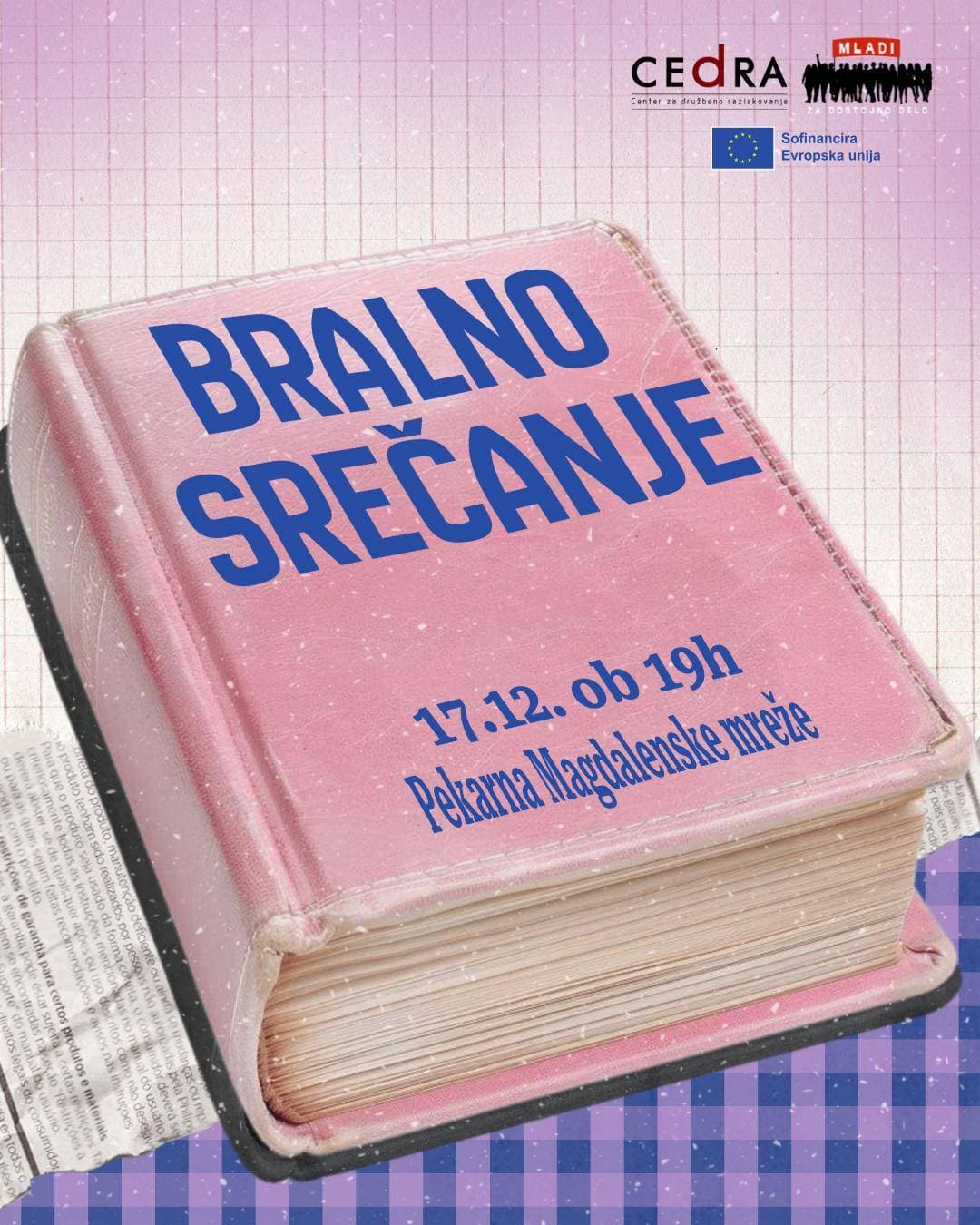
Reading class - The Labour Market and the Composition of the Working Class
Activity Report
Activity Report
Event Report: Reading Session – The Labour Market and the Composition of the Working Class
Date: 17 December 2025
Context: Erasmus+ project Youth for Decent Work, the Common Good and the Environment (KA145)
Location: Pekarna Magdalenske mreže, Maribor
1. Description of the Activity
As part of the project, we organised a reading session focusing on Rastko Močnik's text The Labour Market and the Composition of the Working Class. The session was designed to deepen participants' understanding of the concept of the labour market and the relationships between capital, the state and the working class.
Participants read the text before the session, allowing the event to focus primarily on collective interpretation, clarification of more complex concepts and in-depth discussion. In the introductory part, participants highlighted the key points of the text and raised questions and dilemmas that emerged during their reading.
This was followed by a moderated discussion on the ideological function of the concept of the “labour market”, the relationship between production and broader social processes, and the ways in which the working class is formed and transformed. Particular attention was paid to connecting the theoretical arguments with contemporary forms of work, precarious employment, social inequalities and young people's experiences in the world of work.
2. Purpose of the Activity
The objectives of the reading session were:
- to deepen participants' understanding of the concept of the labour market and class relations,
- to introduce young people to the connections between capital, labour, the state and broader social processes,
- to encourage critical reflection on concepts that are often presented as self-evident or neutral in everyday life and public discourse,
- to connect the theoretical understanding of class relations with contemporary forms of work, particularly precarious employment,
- to develop participants' ability to critically read and interpret more demanding social science texts,
- to encourage reflection on collective organising and possibilities for collective action among workers.
3. Process and Youth Participation
The reading session was structured into several interconnected sections:
a) Reading and Individual Preparation
Before the session, participants read Rastko Močnik's text The Labour Market and the Composition of the Working Class. Reading the text in advance allowed them to become familiar with its main arguments and to come to the session with their own questions, reflections and dilemmas.
b) Collective Interpretation of the Text
In the introductory part of the session, participants highlighted the key points of the text as well as sections they found particularly important or challenging to understand. Together, we clarified more complex concepts and compared different interpretations of the text.
This approach encouraged active participation and created a space in which participants could deepen their understanding through collective discussion.
c) Critical Reflection on the Concept of the “Labour Market”
The central part of the discussion focused on the concept of the “labour market”. Participants reflected on the extent to which this concept adequately describes the relationship between workers and capital, and on the power relations that may be obscured when labour is presented as a commodity that individuals freely exchange on the market.
This opened up a broader discussion about how the language and concepts we use to describe social relations can influence our understanding of social reality.
d) Capital, the State and the Composition of the Working Class
The discussion then turned to the relationships between capital, the state and the working class. We examined how production and broader social processes influence the position of workers and how economic, technological and social changes affect the composition and position of the working class.
Particular attention was paid to the fragmentation of workers and to differences between various forms and conditions of employment.
e) Precarious Work and Collective Organising
In the final part of the session, participants connected the theoretical concepts with contemporary forms of work and their own experiences. Particular attention was given to precarious employment, employment insecurity and the different situations young people face when entering the labour market.
The discussion also addressed collective organising. Participants reflected on how the fragmentation of workers affects possibilities for collective action and on the role that solidarity, cooperation and collective organising can play in improving working and living conditions.
4. Achieved Results
The activity was evaluated through a questionnaire and a group reflection. Participants assessed their understanding of the concept of the labour market and class relations, their ability to connect theory with contemporary forms of work, the contribution of the activity to the development of critical thinking, and the quality of the group discussion.
The average scores on a five-point scale were:
- understanding of the concept of the labour market: 4.5 / 5,
- understanding of class relations: 4.6 / 5,
- connecting theory with practice: 4.5 / 5,
- contribution to the development of critical thinking: 4.7 / 5,
- quality of the group discussion: 4.6 / 5.
Participants particularly highlighted that the session helped them better understand that the “labour market” is not necessarily a neutral concept but reflects particular social relations and power relations.
Another important outcome of the session was the connection between theoretical concepts and participants' own experiences of precarious and other forms of work. Participants identified collective organising as an important topic and as one possible response to the fragmentation and unequal position of workers.
The activity therefore contributed to:
- a better understanding of the concept of the labour market and class relations,
- a deeper understanding of the connections between capital, labour, the state and social processes,
- the development of a critical approach to social and economic concepts that are often taken for granted,
- connecting theoretical concepts with contemporary forms and experiences of work,
- a better understanding of precarious employment and the fragmentation of workers,
- reflection on the importance of solidarity and collective organising.
5. Learning Outcomes and Contribution to the Project Objectives
The reading session made an important contribution to the objectives of the project, particularly in the areas of understanding decent work, social inequalities, critical thinking and active citizenship among young people.
In terms of knowledge, participants deepened their:
- understanding of the concept of the labour market as a socially constructed phenomenon,
- knowledge of class relations and the role of the state,
- understanding of the connections between capital, labour and broader social processes,
- understanding of contemporary changes in the composition and position of the working class,
- understanding of the connections between theoretical concepts and contemporary forms of precarious work.
In terms of skills, participants developed their:
- ability to critically read and interpret more demanding social science texts,
- ability to analyse abstract social and economic concepts,
- ability to connect theory with concrete examples and their own experiences,
- ability to participate in an in-depth group discussion and formulate arguments,
- ability to critically evaluate concepts and explanations that are often presented as self-evident in public discourse.
In terms of attitudes and behaviour, the activity contributed to:
- a greater willingness to reflect on social structures and power relations,
- increased awareness of social and economic inequalities,
- the development of a critical approach to social concepts that are often taken for granted,
- greater awareness of the importance of solidarity and collective action,
- increased motivation for further learning and active engagement with social issues.
The activity therefore directly supported the objectives of the Erasmus+ project Youth for Decent Work, the Common Good and the Environment by enabling young people to develop a deeper understanding of the world of work and social inequalities, while encouraging them to think critically about their own position, collective action and opportunities to actively participate in shaping society.