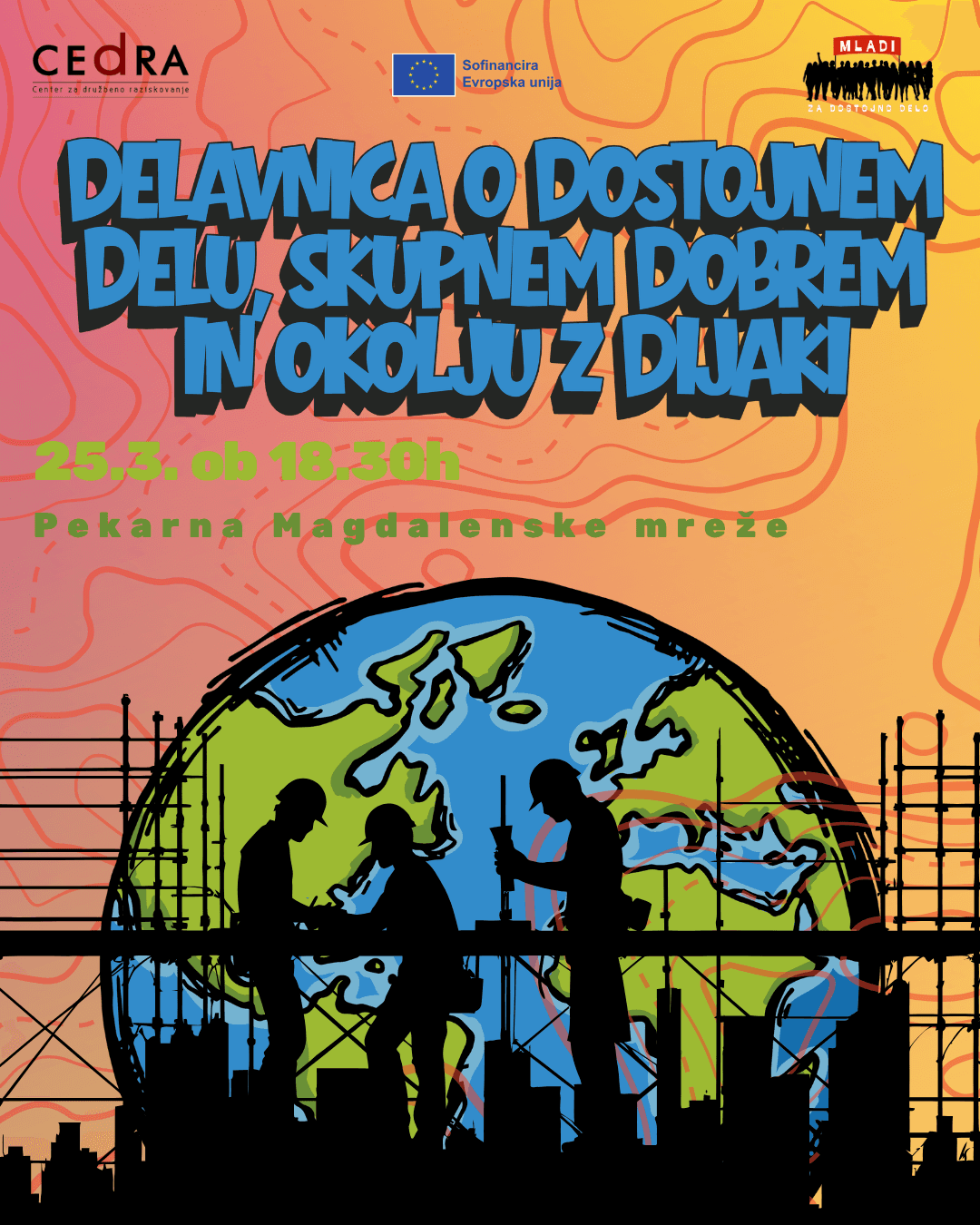
Workshop on Decent Work, the Common Good and the Environment with Secondary School Students
Activity Report
Activity Report
Event Report: Workshop on Decent Work, the Common Good and the Environment with Secondary School Students
Date: 25 March 2026
Context: Erasmus+ project Youth for Decent Work, the Common Good and the Environment (KA145)
Location: Pekarna Magdalenske mreže, Ob železnici 6, 2000 Maribor
1. Description of the Activity
As part of the project, we organised a workshop with secondary school students focusing on the connections between decent work, the common good, environmental problems and broader social and economic processes.
A distinctive feature of the activity was that participants worked with concrete environmental problems from their own local environments and then connected them with issues related to working conditions, economic interests, industrial production, political decision-making and responsibility towards communities.
In the introductory part, we examined examples from different countries represented by the participants. In Slovenia, we focused on the case of Anhovo and the impact of industry and waste incineration on the environment, quality of life and the health of local residents. Participants from Serbia presented the Rio Tinto project and related concerns about pollution, the use of natural resources and impacts on local communities. We also discussed the broader problem of air quality in urban areas.
Participants then worked in groups to analyse the causes of the selected problems, identify key actors and their interests, and consider how environmental problems are connected with the organisation of the economy, working conditions and political decisions. The final part focused on a collective discussion about opportunities for young people to participate actively and engage within their communities.
2. Purpose of the Activity
The objectives of the workshop were:
- to deepen participants' understanding of the connections between the environment, work, the economy and society,
- to introduce young people to concrete environmental problems from different local and national contexts,
- to encourage an understanding of the impact of industrial and economic interests on the environment and local communities,
- to develop participants' ability to identify key actors and interests in environmental conflicts,
- to encourage comparative thinking between different countries and social contexts,
- to strengthen critical thinking, solidarity and young people's willingness to engage actively with social and environmental issues.
3. Process and Youth Participation
The workshop was structured into several interconnected sections:
a) Introduction to the Connections Between the Environment, Work and Society
In the introductory part, we explored why environmental problems cannot be understood separately from social and economic conditions.
Participants reflected on how industrial production, the organisation of work, corporate economic interests and political decisions can influence environmental quality and people's everyday lives.
b) The Case of Anhovo in Slovenia
As an example from Slovenia, we discussed the case of Anhovo and the impact of industry and waste incineration on the environment and local residents.
Participants analysed how questions of employment, economic interests, health, environmental quality, corporate responsibility and the role of the state and local institutions intersect in such cases.
The example provided a basis for discussing the difficulties involved in balancing different interests and the importance of considering the long-term consequences of environmental decisions for local communities.
c) The Rio Tinto Case and Environmental Problems in Serbia
Participants from Serbia presented the Rio Tinto project and concerns related to the potential environmental impacts of mining activities, natural resource use and effects on local communities.
The discussion also expanded to the issue of air quality in urban areas and to broader questions about the impact of industrial and energy policies on people's everyday lives.
This enabled participants to bring their own experiences and knowledge of their local environments directly into the workshop.
d) Group Work and Analysis of Key Actors
During the practical part of the workshop, participants worked in small groups to analyse the selected cases. They identified key actors, their interests, power relations and the groups most affected by particular decisions.
They also considered the roles of companies, the state, local authorities, workers, residents and civil society both in the emergence of environmental problems and in the search for solutions.
e) International Comparison and Common Patterns
Comparing examples from different countries enabled participants to identify similar patterns despite different local circumstances.
Participants observed that many environmental conflicts involve recurring questions concerning the relationship between economic interests and the common good, the unequal distribution of benefits and negative consequences, and the limited ability of individuals and local communities to influence decision-making.
f) Active Participation and Group Reflection
In the final part of the workshop, we discussed the possibilities available to young people for engaging with environmental and social problems.
Participants reflected on the importance of access to information, public discussion, community organising, solidarity and collective action. Particular emphasis was placed on understanding active citizenship as something that can include both local initiatives and broader social and political participation.
4. Achieved Results
The activity was evaluated through a questionnaire and group reflection. Participants assessed their understanding of the connections between the environment, work and society, their understanding of local environmental problems, the value of international comparison, the relevance of the topics discussed and the activity's contribution to their motivation to become actively involved.
The average scores on a five-point scale were:
- understanding of the environment–work–society connection: 4.7 / 5,
- understanding of local environmental problems: 4.6 / 5,
- value of international comparison: 4.7 / 5,
- relevance of the topics discussed: 4.6 / 5,
- motivation for active involvement: 4.4 / 5.
Participants particularly highlighted that the workshop helped them connect environmental problems with working conditions, economic interests and political decisions. This enabled them to begin understanding individual environmental cases as part of broader social processes rather than as isolated local problems.
The international comparison was particularly highly valued, as participants recognised similar patterns in relationships between industry, local communities, the state and the environment despite differences between countries.
The workshop also encouraged participants to reflect on their own role and on possibilities for becoming informed, cooperating with others and taking active part in their communities.
The activity therefore contributed to:
- a better understanding of the connections between the environment, work and broader social processes,
- deeper knowledge of concrete environmental problems in different countries,
- an understanding of the impact of industrial, economic and political decisions on the environment,
- the development of comparative and critical thinking,
- the ability to identify key actors and interests,
- greater awareness of opportunities for active citizenship and collective action.
5. Learning Outcomes and Contribution to the Project Objectives
The workshop made an important contribution to the objectives of the project by enabling young people to connect issues of decent work, the common good and environmental justice through concrete examples from their local environments.
In terms of knowledge, participants deepened their:
- understanding of local environmental problems in different countries,
- knowledge of the connections between the environment, work and economic systems,
- understanding of the impact of industry and political decision-making on the environment and local communities,
- understanding of the relationships between economic interests, the common good and environmental consequences,
- knowledge of the importance of active citizenship in addressing social and environmental problems.
In terms of skills, participants developed their:
- ability to analyse concrete real-life cases,
- ability to identify key actors, interests and power relations,
- ability to think comparatively across different countries and contexts,
- ability to cooperate effectively in group work,
- ability to express opinions in a reasoned manner and participate in discussion.
In terms of attitudes and behaviour, the activity contributed to:
- greater awareness of environmental and social problems,
- a stronger sense of responsibility towards local and wider communities,
- greater willingness to participate in discussion and become actively involved,
- greater openness to understanding the experiences of people from different environments,
- stronger solidarity between participants from different countries and social contexts.
The activity therefore directly supported the objectives of the Erasmus+ project Youth for Decent Work, the Common Good and the Environment by enabling young people to understand the interconnected nature of labour, social and environmental issues, develop critical thinking, and reflect on their own role in creating more just, supportive and environmentally responsible communities.