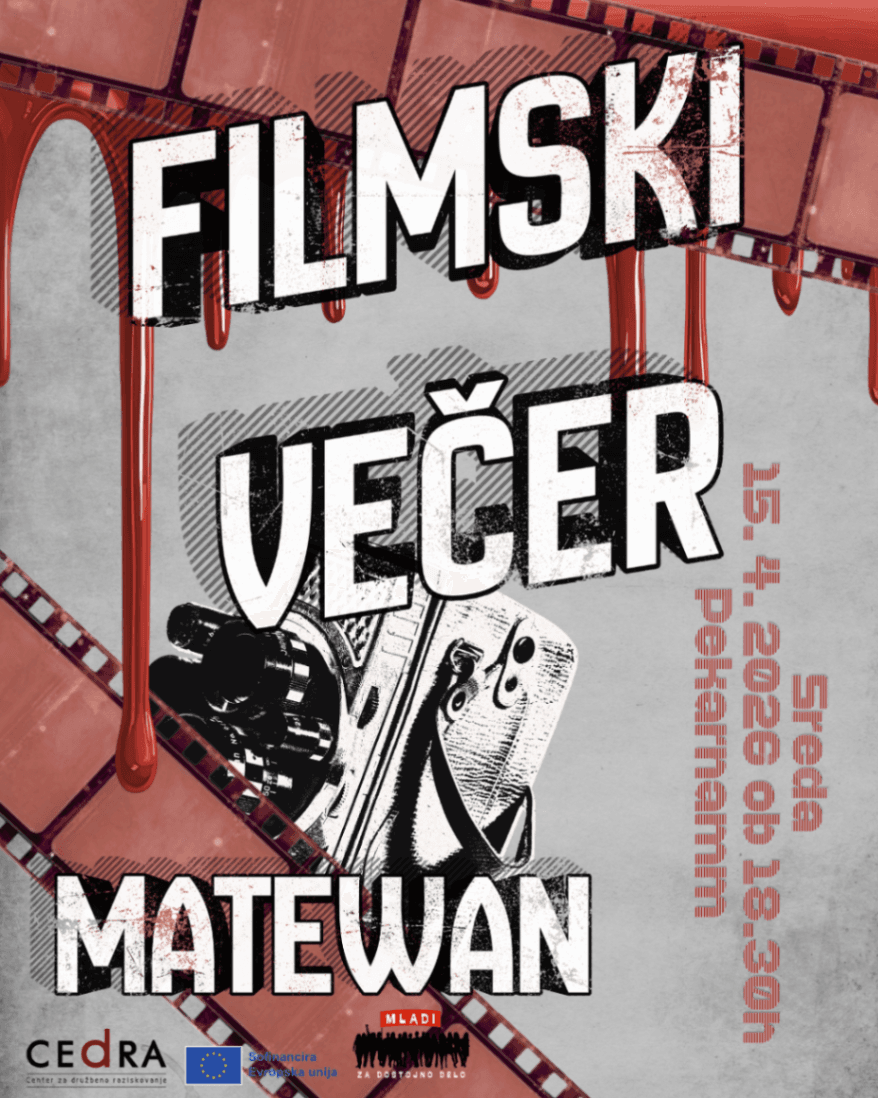
Film Evening – Matewan
Activity Report
Activity Report
Event Report: Film Evening – Matewan
Date: 14 May 2026
Context: Erasmus+ project Youth for Decent Work, the Common Good and the Environment (KA145)
Location: Pekarna Magdalenske mreže, Ob železnici 6, 2000 Maribor
1. Description of the Activity
As part of the project, we organised the third event in our series of film evenings on workers' rights, decent work and the common good. We screened Matewan (1987), a film that explores workers' rights, trade union organising, strikes, solidarity and power relations between workers and companies through the story of a community of mine workers and their efforts to organise collectively.
Particular attention was paid to the process of collective organising. Through the film, participants observed how workers attempt to build collective organisation despite the differences between them and how the company seeks to weaken their efforts through replacement workers, pressure and the creation of divisions between different groups of workers.
Following the screening, participants took part in a moderated discussion on the importance of trade union organising, strikes and workers' solidarity. They analysed how racial, ethnic, social and other divisions can weaken workers' capacity to act collectively and how such differences can be used to maintain unequal power relations.
The film also provided a starting point for comparing historical forms of workers' organising with contemporary conditions in the world of work and for reflecting on the continuing relevance of collective organisation.
2. Purpose of the Activity
The objectives of the film evening were:
- to use film as a medium to introduce young people to the importance of trade union organising and strikes,
- to deepen their understanding of power relations between workers, companies and institutions,
- to introduce historical examples of workers' organising and conflicts between labour and capital,
- to encourage reflection on the mechanisms that can be used to prevent or weaken workers' collective organisation,
- to emphasise the importance of overcoming racial, ethnic, social and other divisions between workers,
- to develop an understanding of solidarity as an important condition for effective collective action,
- to connect historical experiences of workers' organising with contemporary working conditions and challenges.
3. Process and Youth Participation
The film evening was structured into several interconnected sections:
a) Introduction and Context of the Film
Before the screening, participants were introduced to the basic historical and social context of Matewan. Particular attention was paid to workers' organising, trade unions, strikes and conflicts between the interests of workers and companies.
Participants were encouraged to pay attention to the relationships between different groups of workers, the ways in which they organised and the mechanisms used by the company to prevent them from building collective organisation.
b) Film Screening
Participants watched Matewan together. The film enabled them to follow the development of a workers' collective from initial mistrust and division towards the gradual development of solidarity and collective action.
Particular attention was paid to the role of trade union organising and strikes and to the question of how collective action can change the balance of power between individual workers and a company.
c) Trade Union Organising and Strikes
Following the screening, we discussed the role of a trade union as a structure that enables individual workers to come together around shared interests.
Participants analysed the importance of strikes as a form of collective action and considered why a group of organised workers occupies a different position from an individual worker confronting an employer alone.
d) Mechanisms for Preventing Collective Organisation
An important part of the discussion focused on the methods used by the company in the film to weaken the strike and workers' organising efforts.
Participants identified the use of replacement workers, pressure, intimidation and the encouragement of conflicts between different groups as methods of weakening workers' collective power.
The discussion also enabled participants to compare these historical examples with different forms of pressure and obstacles that workers may encounter when organising today.
e) Divisions Between Workers and the Importance of Solidarity
The central part of the discussion focused on relationships between different groups of workers. Participants analysed how racial, ethnic, social and other differences can affect possibilities for collective action.
We particularly discussed the idea that differences themselves do not necessarily prevent solidarity; what matters is whether different groups are able to overcome divisions and recognise their shared interests.
The film therefore provided an opportunity to reflect on solidarity based on a shared position and collective action despite differences between individuals.
f) Connecting the Film with Contemporary Working Conditions
In the final part of the event, participants compared the conditions presented in the film with the contemporary world of work.
They discussed how workers' organising has changed over time, which problems remain similar and what role trade unions, solidarity and collective action can play in contemporary struggles for decent work and workers' rights.
4. Achieved Results
The activity was evaluated through a questionnaire and group reflection. Participants assessed their understanding of trade union organising, the importance of strikes and collective action, the impact of divisions between workers, power relations between workers and companies, and the relevance of the film's themes to contemporary working conditions.
The average scores on a five-point scale were:
- understanding of the importance of trade union organising: 5 / 5,
- understanding of the importance of strikes and collective action: 4.5 / 5,
- understanding of the impact of divisions between workers: 4 / 5,
- understanding of power relations between workers and companies: 4.5 / 5,
- relevance of the themes to contemporary working conditions: 4.5 / 5.
Participants identified solidarity between workers across racial, ethnic and other differences as one of the film's key themes. The discussion demonstrated an understanding that divisions between different groups of workers can weaken their collective power and benefit those seeking to prevent them from organising.
Particular emphasis was placed on the role of trade unions as structures that bring individual workers together into a collective and enable them to represent their shared interests more effectively. Through the film, participants also developed a better understanding of strikes as a collective means through which workers can influence the balance of power.
The activity therefore contributed to:
- a better understanding of the importance of trade union organising,
- a deeper understanding of strikes and collective action,
- recognition of different methods used to prevent or weaken workers' organising,
- an understanding of how divisions between workers affect their collective power,
- an understanding of the importance of solidarity between workers from different backgrounds,
- connecting historical experiences of workers' organising with contemporary working conditions.
5. Learning Outcomes and Contribution to the Project Objectives
The film evening made an important contribution to the objectives of the project by enabling young people to develop a deeper understanding of workers' rights, trade union organising, collective action and solidarity through a concrete historical example.
In terms of knowledge, participants deepened their:
- understanding of the importance of trade union organising and strikes,
- knowledge of historical forms of workers' organising and conflicts between labour and capital,
- understanding of the importance of solidarity between workers from different racial, ethnic and social backgrounds,
- understanding of power relations between workers, companies and local institutions,
- knowledge of different mechanisms that can be used to prevent or weaken collective organisation.
In terms of skills, participants developed their:
- ability to critically analyse labour and social relations through film,
- ability to recognise mechanisms used to create and exploit divisions between different groups of workers,
- ability to analyse power relations between different social actors,
- ability to connect historical examples of workers' organising with contemporary working conditions,
- ability to participate in reasoned group discussions.
In terms of attitudes and behaviour, the activity contributed to:
- stronger solidarity with workers regardless of their background or social position,
- greater willingness to consider collective approaches to solving problems,
- a better understanding of the importance of overcoming divisions in collective action,
- greater willingness to participate in discussions about workers' rights and decent work,
- greater awareness of the importance of organising and solidarity in advancing shared interests.
The activity therefore directly supported the objectives of the Erasmus+ project Youth for Decent Work, the Common Good and the Environment, particularly by deepening young people's understanding of workers' rights, trade union organising, solidarity and collective action, while developing their ability to critically understand power relations in the world of work.