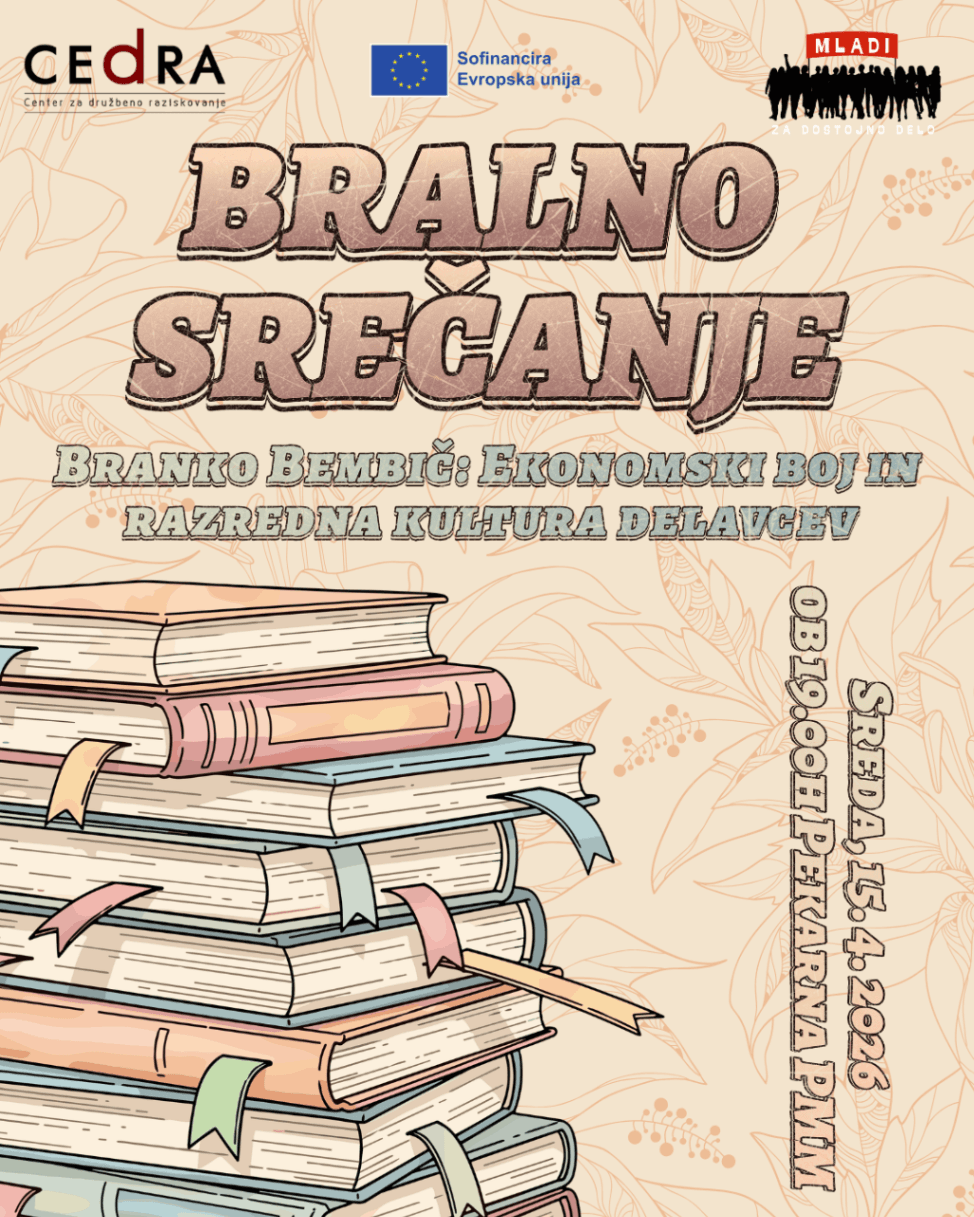
Reading Session – Branko Bembič: Economic Struggle and the Class Culture of Workers
Activity Report
Activity Report
Event Report: Reading Session – Branko Bembič: Economic Struggle and the Class Culture of Workers
Date: 15 April 2026
Context: Erasmus+ project Youth for Decent Work, the Common Good and the Environment (KA145)
Location: Pekarna Magdalenske mreže, Ob železnici 6, 2000 Maribor
1. Description of the Activity
As part of the project, we organised a reading session focusing on Branko Bembič's article Economic Struggle and the Class Culture of Workers. The session was designed to deepen participants' understanding of the significance of workers' economic struggles and their role in developing solidarity, collective consciousness and class culture.
Participants read the text before the session, allowing the event to focus primarily on the collective interpretation of its key arguments, clarification of more complex concepts and connections between the theoretical perspectives presented in the text and contemporary conditions in the world of work.
Particular attention was paid to the idea that the significance of economic struggle is not limited to achieving immediate material improvements, such as higher wages or better working conditions. Collective efforts to pursue shared interests can also bring workers together, develop solidarity, strengthen collective organisation and contribute to a shared understanding of their position within society.
2. Purpose of the Activity
The objectives of the reading session were:
- to deepen participants' understanding of the significance of workers' economic struggles,
- to explore the relationship between economic struggle, collective action and solidarity,
- to introduce young people to the concept of class culture and the processes through which it develops,
- to encourage reflection on the role of trade unions and other forms of workers' organisation,
- to connect theoretical concepts with contemporary changes in the world of work,
- to develop participants' ability to critically read, engage in reasoned discussion and understand broader social processes.
3. Process and Youth Participation
The reading session was structured into several interconnected sections:
a) Reading and Collective Interpretation of the Text
Before the session, participants read Branko Bembič's article Economic Struggle and the Class Culture of Workers. At the beginning of the session, they highlighted sections they considered particularly important and raised questions and dilemmas that emerged during their reading.
Through collective interpretation, we clarified more complex concepts and established a shared basis for further discussion.
b) Economic Struggle and Workers' Material Interests
The discussion then addressed the significance of economic struggle and the concrete interests around which workers organise and act collectively.
We discussed wages, working conditions, working time, employment security and other material aspects of employment. Particular attention was paid to how struggles for concrete improvements can provide a starting point for broader connections and cooperation among workers.
c) From Individual Problems to Collective Action
An important part of the discussion focused on the transition from an individual to a collective understanding of problems.
Participants considered how problems initially experienced as personal can, through discussion and collective activity, be recognised as problems shared by a larger group of workers. Recognising common interests can provide an important basis for developing collective organisation and solidarity.
d) Solidarity and Class Culture
The central part of the session focused on the concept of class culture. We discussed how shared experiences, mutual support and collective action can contribute to the development of solidarity and a sense of belonging to a broader collective.
Participants reflected on the idea that solidarity does not necessarily exist before collective action begins, but can itself develop through shared struggles, experiences and organising.
e) Trade Unions, Organising and the Contemporary World of Work
We then connected the theoretical concepts with contemporary conditions in the world of work. The discussion addressed the role of trade unions and other forms of collective organisation, as well as the challenges created by precarious employment, the individualisation of employment relations and the fragmentation of workers.
Participants considered possibilities for developing solidarity and collective action even in circumstances where workers have different employment statuses and working conditions.
f) Group Reflection
In the final part of the session, participants connected the concepts discussed with contemporary examples and their own understanding of the world of work.
The discussion focused on the significance of collective action, solidarity and organising both for improving working conditions and for strengthening people's broader capacity to influence social processes together.
4. Achieved Results
The activity was evaluated through a questionnaire and group reflection. Participants assessed their understanding of economic struggle, the relationship between solidarity and collective action, the concept of class culture, the relevance of the topics discussed and the activity's contribution to the development of critical thinking.
The average scores on a five-point scale were:
- understanding of economic struggle: 4.6 / 5,
- understanding of solidarity and collective action: 4.7 / 5,
- understanding of class culture: 4.6 / 5,
- relevance of the topics discussed: 4.5 / 5,
- contribution to the development of critical thinking: 4.7 / 5.
The activity enabled participants to develop a deeper understanding of economic struggle as a process whose significance extends beyond immediate material outcomes. Through the discussion, participants recognised that collective efforts to improve wages, working conditions and other rights can also contribute to developing more lasting relationships between workers.
Another important outcome was a better understanding of the relationship between collective action and solidarity. Participants discussed how mutual trust, shared identity and the capacity for further organising can develop through collective action.
The activity therefore contributed to:
- a better understanding of the significance of economic struggle,
- a deeper understanding of the relationship between material interests and collective action,
- an understanding of the concept of class culture and the processes through which it develops,
- a better understanding of the importance of solidarity among workers,
- critical reflection on the role of trade unions and organising,
- connecting theoretical concepts with contemporary conditions in the world of work.
5. Learning Outcomes and Contribution to the Project Objectives
The reading session made an important contribution to the objectives of the project by enabling young people to develop a deeper understanding of the collective dimensions of the world of work and the importance of solidarity, organising and collective action in improving working and living conditions.
In terms of knowledge, participants deepened their:
- understanding of the significance of workers' economic struggles,
- knowledge of the concept of class culture,
- understanding of the relationship between economic struggle, solidarity and collective action,
- understanding of the role of trade unions and other forms of workers' organisation,
- understanding of contemporary changes in the world of work and their consequences for possibilities for collective action.
In terms of skills, participants developed their:
- ability to critically read and interpret complex theoretical texts,
- ability to analyse social and economic concepts,
- ability to connect theory with contemporary examples from the world of work,
- ability to participate in in-depth group discussions,
- ability to formulate reasoned arguments and engage with different perspectives.
In terms of attitudes and behaviour, the activity contributed to:
- greater willingness to engage in collective action,
- increased awareness of social and economic inequalities,
- a stronger understanding of the importance of solidarity,
- greater openness to cooperation and building connections with others,
- increased motivation to participate actively in social processes.
The activity therefore directly supported the objectives of the Erasmus+ project Youth for Decent Work, the Common Good and the Environment, particularly by deepening young people's understanding of decent work, workers' rights, solidarity and collective organising, while developing their capacity to critically understand and actively contribute to shaping social relations.